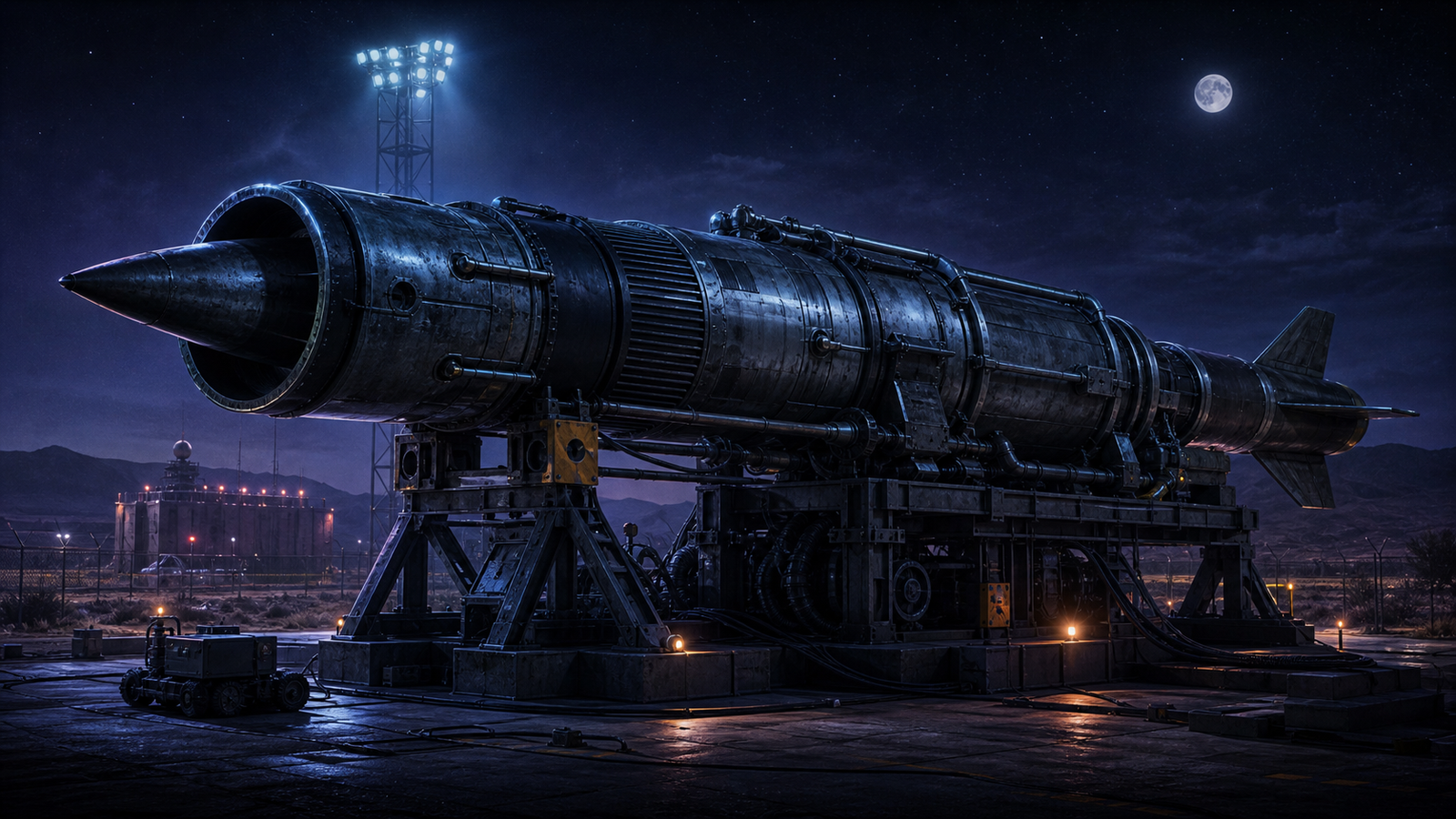
Project PLUTO Nuclear Ramjet Missile Program
Project PLUTO is one of the rare Cold War weapons programs where the nickname sounds exaggerated until the records make it worse.
A nuclear-powered ramjet missile.
Not a reactor for a submarine. Not a reactor for a spacecraft. Not a nuclear warhead carried by a conventional missile.
A reactor as the engine.
The public record identifies Project PLUTO as a real U.S. effort to develop nuclear ramjet propulsion for the Supersonic Low Altitude Missile, usually shortened to SLAM. The program sat at the intersection of the U.S. Air Force, the Atomic Energy Commission, Lawrence Radiation Laboratory / Lawrence Livermore, and the Nevada Test Site.
The idea was simple enough to explain and difficult enough to become nearly insane.
A missile moving at extreme speed would ram air into an inlet. That air would pass through a nuclear reactor core. The reactor would heat the air. The expanding air would blast out the back as thrust.
No ordinary fuel burn was needed once the ramjet was moving fast enough.
That gave the missile its strategic seduction: long range, low altitude, high speed, nuclear payload, and the possibility of loitering, redirecting, or attacking multiple targets.
It also gave the missile its horror: an unshielded reactor screaming through the atmosphere, leaving radioactive exhaust and sonic violence in its path.
That is why PLUTO belongs in the Black Echo archive.
It is not a UFO legend. It is not a mythic anti-gravity craft. It is not an alleged alien reverse-engineering file.
It is a verified Cold War engineering project that tried to make the sky itself part of a nuclear engine.
The first thing to understand
Project PLUTO was real.
That matters.
The hard evidence is not a rumor board or a whistleblower monologue. It sits in Department of Energy and OSTI technical records, Lawrence Livermore historical material, Nevada Test Site facility documentation, and later historical analysis.
A 1959 OSTI record identifies Tory II-A as the first test reactor in the Pluto program and says it led toward development of a nuclear ramjet engine. It describes Tory II-A as a reactor that was not yet an actual prototype engine but embodied a core design considered feasible for an engine. [1]
A 1961 OSTI record describes Tory II-A as successfully tested and discusses control-system development for Tory II-C, identified as a flight-type ramjet reactor. [2]
That is the core evidence boundary.
The engine line was real. The reactor tests were real. The SLAM missile concept was real. The deployed weapon was not.
What PLUTO was trying to build
Project PLUTO was the propulsion half of a strategic missile dream.
That matters.
The missile concept was called SLAM, the Supersonic Low Altitude Missile.
The basic aim was to create a nuclear-powered cruise missile that could fly at very high speed and very low altitude. Instead of burning fuel like a normal jet or rocket, the missile would use a reactor to heat incoming air. The ramjet would only work after another system accelerated the vehicle to the required speed; then the nuclear ramjet would take over.
In normal jet propulsion, fuel burns and heats air.
In PLUTO, the reactor was the heat source.
That single substitution changed everything.
It promised enormous range because the missile did not need to carry ordinary engine fuel for cruise. It also made the missile politically radioactive before it ever left the test stand.
The ramjet idea
A ramjet is simple in outline.
It has no turbine like a turbojet. It relies on forward speed to force air into the engine. The air is slowed and compressed by the inlet geometry. Heat is added. The hot gas expands out the nozzle. The engine produces thrust.
A nuclear ramjet keeps the same basic air-breathing logic but changes the heat source.
Instead of burning hydrocarbon fuel, the reactor core heats the air directly.
That is why Project PLUTO is different from the nuclear rocket programs around Rover, NERVA, Phoebus, Pewee, and Nuclear Furnace.
Those programs heated a carried propellant, usually hydrogen, for space propulsion. PLUTO heated atmospheric air for missile propulsion.
NERVA wanted to leave the atmosphere. PLUTO wanted to weaponize it.
Why SLAM looked attractive
The Cold War logic behind PLUTO was not subtle.
A low-flying missile could try to stay below radar coverage. A supersonic missile could reduce reaction time. A nuclear-powered missile could, in theory, fly for extreme ranges. A large cruise vehicle could carry multiple nuclear warheads. A missile that did not follow a ballistic arc could complicate warning and interception.
That made SLAM appear attractive before ICBM reliability and accuracy matured.
The missile was imagined as a terrain-skimming strategic intruder: too low for early warning, too fast for easy interception, too long-ranged for ordinary defense planning, and carrying enough nuclear payload to strike multiple targets.
That is why the nickname flying crowbar stuck.
It suggested not only speed and bluntness, but also a kind of weaponized mechanical arrogance.
The Lawrence Livermore role
Project PLUTO was centered at Lawrence Radiation Laboratory, later Lawrence Livermore National Laboratory.
That matters.
Livermore was one of the key U.S. nuclear weapons laboratories, and PLUTO gave it a problem that was almost perfectly Atomic Age in character: make a reactor small enough, powerful enough, hot enough, and rugged enough to function as the heart of a missile engine.
The reactor would have to survive intense temperature, airflow, vibration, and control demands. It would have to operate in a radiation environment hostile to ordinary mechanisms. It would have to avoid melting while serving as the heat exchanger for a screaming airstream.
The engineering problem was not simply "make a reactor."
It was: make a reactor behave like a jet engine component.
Tory II-A: the proof-of-core reactor
Tory II-A was the first major test reactor in the PLUTO line.
That matters.
The 1959 OSTI abstract describes Tory II-A as the first test reactor in the Pluto program and says its operation would test a core type considered feasible for a nuclear ramjet engine. It states that the central objective was operation at 160 megawatts, with 800 pounds of air per second passing through the core and emerging at 2000 degrees Fahrenheit. [1]
That tells us what the program was really testing.
Not flight guidance. Not warhead release. Not terrain following. Not operational targeting.
The first question was more fundamental:
Could a compact reactor core survive ramjet-like airflow and temperature?
Tory II-A was the first serious answer.
The desert test stand
A nuclear ramjet cannot be tested like an ordinary engine.
That matters.
A normal jet engine can be mounted and fed fuel. A nuclear ramjet needs enormous airflow to simulate the conditions of supersonic flight.
At the Nevada Test Site, PLUTO's test architecture had to create a substitute for the sky.
Compressed air systems, test bunkers, remote handling, rail-mounted equipment, disassembly facilities, and decontamination infrastructure became the ground version of flight.
In other words, the desert had to become a fake Mach-speed airstream.
That physical infrastructure is part of why PLUTO belongs in the black-project record. The test site was not just a place where a missile idea was discussed. It was where the government built the machinery to make an airborne reactor plausible.
Tory II-C: the flight-type boundary
After Tory II-A came Tory II-C.
That matters.
The 1961 OSTI record says recent control-system developments for Tory II-C, a flight-type ramjet reactor, were being described. It also notes the need for long-stroke servo actuators capable of operating in a high-radiation environment across a very wide temperature range. [2]
That phrase — flight-type — is the boundary.
Tory II-C was not the SLAM missile itself. It was not a deployed weapon. But it was closer to the reactor architecture that a real nuclear ramjet missile would require.
This is where the myth becomes anchored to hardware.
The internet legend says PLUTO was a nuclear-powered doomsday missile. The evidence says the missile never flew.
But the same evidence also says the reactor technology was ground-tested far enough that the myth did not come from nothing.
The control problem
A nuclear ramjet is not only a heat problem.
It is a control problem.
That matters.
The reactor has to respond to changing airflow and power demand. Control hardware has to survive radiation. Actuators, sensors, valves, and feedback mechanisms have to work in an environment that punishes ordinary electronics and mechanical parts.
The OSTI control-system record emphasizes that Tory II-C required control equipment designed for high radiation and temperature extremes. [2]
That is one of the overlooked parts of PLUTO.
The terrifying part is the reactor exhaust. The difficult part is everything else: keeping the reactor stable, controlling power, managing airflow, operating remote systems, and doing it in a missile environment.
A nuclear ramjet is not just a reactor with a nozzle. It is a full weapons system trying to make nuclear heat behave like aircraft propulsion.
The fuel-element challenge
Project PLUTO also depended on materials that could survive a punishing environment.
That matters.
The Tory II-A abstract describes a core composed of bundled ceramic tubes, with central holes providing air passages through the reactor. It identifies the tube material as a homogeneous mixture involving uranium oxide fuel and beryllium oxide moderator, compacted and sintered for strength and density. [1]
That detail is important historically, but it should be read carefully.
This dossier is not a build sheet. It is a record of what the public technical abstract says the program attempted.
The concept required air to flow through reactor fuel structures while absorbing heat. That meant the fuel was not sealed away like a conventional reactor element inside a power plant. The engine concept forced propulsion and reactor physics into the same hot airflow path.
That is why PLUTO's engineering was so extreme.
Why it was called a flying Chernobyl
The phrase flying Chernobyl is modern shorthand.
It is not the program's original official name.
But the reason it sticks is obvious.
A missile powered by an unshielded air-breathing reactor would raise contamination problems even before its warheads were considered. The Bulletin of the Atomic Scientists summarizes the basic propulsion idea as bringing air in, passing it over a reactor to heat it, and expelling it for thrust; it also notes the possibility of very long flight duration compared with chemical propulsion. [4]
The same discussion highlights the central environmental problem: radioactive material release, dangerous test flights, and the political impossibility of safely flying such a system over land or ocean. [4]
That is the paradox of PLUTO.
The better the engine performed, the more unacceptable the full weapon became.
The SLAM weapon concept
The Supersonic Low Altitude Missile was more than an engine demonstrator.
That matters.
It was imagined as a strategic delivery system.
Popular accounts often focus on payload numbers, shock waves, and radioactive exhaust. Those elements belong to the lore, but the strongest evidence has to be separated into categories.
What is verified:
- Project PLUTO developed and ground-tested nuclear ramjet reactor technology.
- Tory II-A and Tory II-C belonged to that effort.
- SLAM was the intended missile application.
- The missile never reached flight or deployment.
What is projected:
- exact operational payload,
- exact route behavior,
- exact mission doctrine,
- exact endurance in a wartime environment,
- and how the weapon would have been used if built.
That distinction matters because PLUTO is already extreme without exaggerating operational certainty.
PLUTO versus NERVA
PLUTO and NERVA are often grouped together because both involved nuclear propulsion.
But they are different beasts.
NERVA was a nuclear thermal rocket program. It heated hydrogen propellant and expelled it through a rocket nozzle for space propulsion.
PLUTO was a nuclear ramjet program. It heated atmospheric air for an air-breathing missile.
NERVA's nightmare was launching and operating nuclear rocket stages. PLUTO's nightmare was flying an open-cycle reactor through the atmosphere.
One was aimed toward Mars-era spaceflight. The other was aimed toward low-altitude strategic penetration.
Both belong in the nuclear aerospace archive. But PLUTO is darker because the reactor exhaust path was part of the weapon's movement through the inhabited atmosphere.
PLUTO versus Orion
Project Orion proposed nuclear pulse propulsion: moving a spacecraft by detonating nuclear devices behind a pusher plate.
PLUTO proposed nuclear ramjet propulsion: moving a missile by heating air inside a reactor.
Both were real Atomic Age concepts. Both sound like science fiction. Both ran into political, environmental, and strategic reality.
But their mythic shapes differ.
Orion is remembered as the giant nuclear starship that might have opened the solar system. PLUTO is remembered as the low-flying nuclear engine that might have poisoned the route to its target.
Orion is cosmic. PLUTO is terrestrial.
That is why PLUTO feels more sinister.
It was not only about reaching space. It was about turning the atmosphere into a weapon corridor.
The environmental wall
The environmental problem was not a footnote.
It was central.
A nuclear ramjet flight test would require choosing a route for a reactor-powered missile. If something went wrong, the vehicle could crash with an active or contaminated reactor. If everything went right, the engine still raised radioactive-exhaust and end-of-mission disposal problems.
The Bulletin notes that testing ideas included concepts such as flying over the Pacific and ditching the reactor into the ocean, but the political and environmental risks were severe. [4]
That is one of the clearest reasons PLUTO died.
A ground test can be isolated. A flight test cannot.
Once the missile leaves the stand, every mile of flight becomes part of the test site.
The military-obsolescence problem
PLUTO also had a strategic timing problem.
That matters.
The program began before intercontinental ballistic missiles fully dominated nuclear-delivery thinking. But by the early 1960s, ICBMs were improving rapidly. Ballistic missiles could reach targets faster, with less operational complexity, and without needing a flying reactor to traverse the atmosphere.
A nuclear-powered low-altitude cruise missile still looked terrifying. But terrifying is not the same as useful.
If ICBMs could do the central deterrence job more cleanly, then SLAM's advantages became harder to justify.
PLUTO became a weapon with:
- a huge test problem,
- a huge environmental problem,
- a huge political problem,
- and a shrinking military niche.
That combination is lethal to a program.
Cancellation
Project PLUTO was cancelled in 1964.
That matters.
The cancellation does not mean the engineering failed in a simple way. The record points to a more complicated story: ground testing showed that major reactor concepts could work, but the missile system was becoming unnecessary, dangerous, and politically unsustainable.
This is one of the strangest black-project endings.
PLUTO was not cancelled because it was obviously impossible. It was cancelled because it was becoming possible enough to force the next questions.
Where do you test it? Where do you fly it? Who accepts the radioactive risk? What does it do that an ICBM cannot do faster? What happens if the missile crashes? What happens if it works exactly as designed?
The answers were not good enough.
Why the myth survived
PLUTO survived in popular culture because it has everything a black-project myth needs: a real codename, a nuclear engine, a secretive test site, a missile that never flew, a terrifying mission concept, and a cancellation that invites "what if" thinking.
The program also has a rare quality: the official record already sounds like a horror story.
That means later mythology does not need to invent much. It only needs to blur the boundary between tested reactor and deployed missile.
That blur is the main thing this dossier corrects.
Project PLUTO was real. Tory II-A and Tory II-C were real. The SLAM missile application was real as a development goal. But there is no public evidence that SLAM became an operational weapon, flew secret missions, or remained hidden as an active U.S. system after cancellation.
What the strongest public record supports
The strongest public record supports a severe but specific conclusion.
It supports that Project PLUTO was a real U.S. nuclear ramjet program connected to the Air Force, the Atomic Energy Commission, Lawrence Radiation Laboratory / Livermore, and the Nevada Test Site; that Tory II-A was the first major test reactor in the program; that Tory II-C was developed as a more flight-type ramjet reactor; that the intended application was the Supersonic Low Altitude Missile; that the system was ground tested rather than operationally flown; and that the program was cancelled in 1964 after technical, military, environmental, and political pressures converged. [1][2][4]
That is the stable core.
What the public record does not clearly support
The public record does not prove every later PLUTO legend.
That matters.
It does not clearly prove:
- that SLAM ever flew under nuclear power,
- that a PLUTO missile was secretly deployed,
- that the United States kept an active PLUTO successor under the same name,
- that the missile conducted hidden test routes over populated regions,
- or that every modern nuclear-powered cruise missile claim descends from a continuing PLUTO program.
Those claims require their own evidence.
The verified file is already extreme enough: a nuclear ramjet engine program for an unflown low-altitude strategic missile.
That is not a small claim. It is the real claim.
Why PLUTO belongs in the black-project archive
Project PLUTO belongs here because it shows what a black project can look like when it is not hidden behind paranormal language.
It looks like:
- an Air Force requirement,
- an Atomic Energy Commission reactor problem,
- a Livermore engineering team,
- a Nevada desert test stand,
- a rail-mounted reactor,
- a compressed-air system powerful enough to fake flight,
- a missile concept built around radioactive heat,
- and a cancellation that arrived only after the concept had been partly proven.
This is black-project history at its most revealing.
Not because the technology was magic. Because the technology was almost practical.
Why it still matters
PLUTO matters because nuclear-powered cruise missiles have returned to public discussion in the twenty-first century.
Whenever a state claims or tests a nuclear-powered missile, Project PLUTO becomes the historical mirror.
It shows that the idea is not new. It also shows why the idea is dangerous even before warhead effects are considered.
A nuclear-powered missile combines three problems:
- propulsion risk,
- weapons risk,
- and contamination risk.
Project PLUTO reached the point where those problems could no longer be hidden behind enthusiasm for range and speed.
That is why the program is more than a strange Cold War footnote.
It is a warning from the era when engineers were asked to make the impossible work, and sometimes nearly did.
Frequently asked questions
Was Project PLUTO real?
Yes. Project PLUTO was a real U.S. Air Force and Atomic Energy Commission nuclear ramjet program run through Lawrence Radiation Laboratory / Lawrence Livermore to develop reactor-powered propulsion for a Supersonic Low Altitude Missile. [1][2]
Did the Project PLUTO missile ever fly?
No. The public record supports ground testing of the Tory nuclear ramjet reactors, not an operational flight of the SLAM missile. PLUTO was cancelled before a nuclear-powered missile deployment.
What were Tory II-A and Tory II-C?
Tory II-A was the early test reactor for the PLUTO nuclear ramjet program. Tory II-C was the more flight-type ramjet reactor developed after Tory II-A, bringing the program closer to a practical engine prototype. [1][2]
Why was Project PLUTO called the flying crowbar?
The nickname reflected the imagined SLAM vehicle: a fast, low-flying, bluntly destructive nuclear-powered missile that would penetrate defenses by speed, altitude, and endurance rather than stealth in the modern sense.
Why was Project PLUTO cancelled?
Project PLUTO was cancelled because ICBM technology advanced quickly, the military requirement weakened, flight testing a radioactive reactor-powered missile was politically and environmentally hazardous, and the system no longer justified its risks.
Does Project PLUTO prove modern secret U.S. nuclear cruise missiles exist?
No. Project PLUTO proves that the United States ground-tested nuclear ramjet reactors during the Cold War. It does not prove a hidden modern deployment or active continuation under the same program name.
Related pages
- Black Projects
- Project NERVA Nuclear Engine Space Program
- Project Nuclear Furnace Reactor Test Program
- Project Peewee Compact Nuclear Engine Program
- Project Phoebus High Power Nuclear Rocket Program
- Project Orion Nuclear Pulse Spacecraft Program
- Project OXCART A-12 CIA Mach 3 Reconnaissance Program
Suggested internal linking anchors
- Project PLUTO nuclear ramjet missile program
- Project Pluto explained
- Project Pluto SLAM missile
- SLAM Supersonic Low Altitude Missile
- Tory II-A nuclear ramjet
- Tory II-C nuclear ramjet
- Lawrence Livermore Project Pluto
- Nevada Test Site nuclear ramjet
- flying crowbar missile
- declassified Project Pluto program
References
- https://www.osti.gov/biblio/4333232
- https://www.osti.gov/biblio/4829009
- https://www.llnl.gov/sites/www/files/1955.pdf
- https://thebulletin.org/2019/08/project-pluto-and-trouble-with-the-russian-nuclear-powered-cruise-missile/
- https://www.osti.gov/biblio/4217328
- https://www.osti.gov/biblio/4169961
- https://www.osti.gov/servlets/purl/807288
- https://www.osti.gov/servlets/purl/1844192
- https://www.osti.gov/servlets/purl/2397
- https://www.jstor.org/stable/23786203
- https://www.astronautix.com/s/slam.html
- https://www.armscontrolwonk.com/archive/1205006/russias-nuclear-powered-cruise-missile/
- https://large.stanford.edu/courses/2015/ph241/rossi1/
- https://www.fourmilab.ch/documents/pluto/
Editorial note
This entry treats Project PLUTO as a verified U.S. nuclear ramjet program, not as proof of a secretly deployed doomsday missile.
That distinction matters.
The official record is already dark: a nuclear ramjet, Tory test reactors, a low-altitude strategic missile concept, Livermore engineering, Nevada Test Site infrastructure, radioactive exhaust concerns, and cancellation before flight.
The evidence supports that.
It does not require embellishment.
Project PLUTO belongs in the Black Echo archive because it shows a specific kind of Cold War extremity: not fantasy technology, but technology close enough to work and dangerous enough that success became part of the problem.