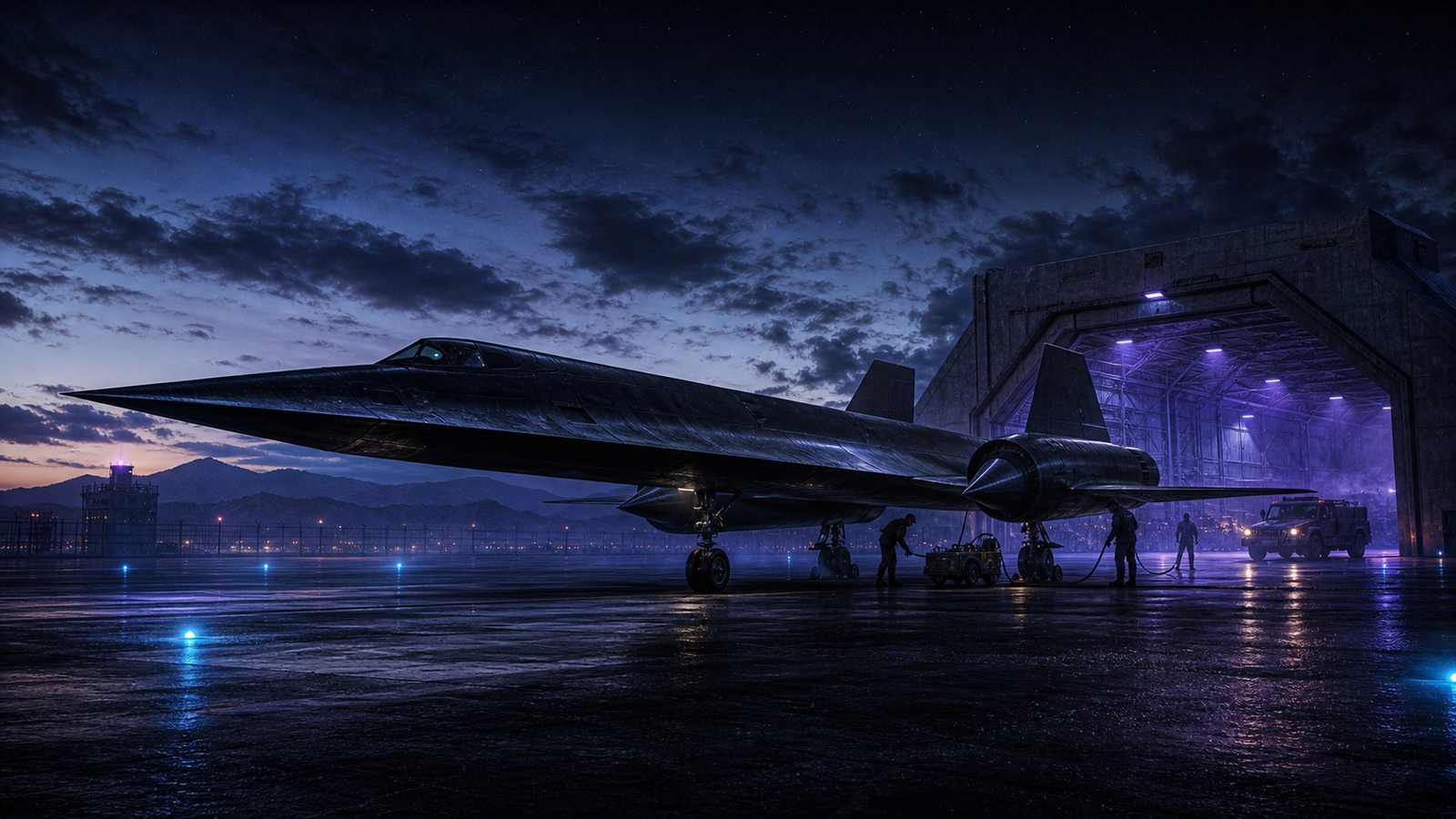
Project OXCART A-12 CIA Mach 3 Reconnaissance Program
Project OXCART was one of the cleanest examples of a real black project.
It did not need aliens.
It did not need antigravity.
It did not need impossible physics.
The official record is already enough:
A CIA aircraft, built by Lockheed Skunk Works, tested at Groom Lake, designed to fly above 90,000 feet, sustained at Mach 3-class speeds, shaped and treated to reduce radar detectability, operated from a secret East Asia detachment, and retired before most of the public understood what it had been.
That is the core.
OXCART produced the Lockheed A-12, the CIA's single-seat Blackbird predecessor to the better-known Air Force SR-71.
It was born from the same Cold War pressure that created the U-2, CORONA satellites, and the entire American overhead reconnaissance machine: the need to see inside denied territory before the enemy could hide, move, launch, or strike.
The first thing to understand
Project OXCART was real.
That matters.
The CIA identifies the A-12 OXCART as a highly secret aircraft developed as the U-2's successor, intended to meet the need for a very fast, very high-flying reconnaissance platform able to avoid Soviet air defenses. The CIA says it awarded the OXCART contract to Lockheed in 1959.
This was not a rumor created by Area 51 culture.
It was a real CIA program.
The aircraft existed. The base existed. The pilots existed. The missions existed. The losses existed. The declassified files exist.
Why the CIA needed OXCART
The U-2 solved one problem and created another.
That matters.
The U-2 could fly high enough to make early interception difficult, but it was not invisible. Soviet radar could track it. Air-defense technology was improving. The United States knew that the U-2's apparent safety would not last forever.
OXCART was the next answer.
Instead of only flying high, the new aircraft had to fly:
- higher,
- much faster,
- with a smaller radar signature,
- with better cameras,
- with electronic countermeasures,
- and with enough reliability to return usable intelligence.
The requirement was extreme because the mission was extreme.
A reconnaissance aircraft over denied territory is not just another airplane. It is a political event waiting to happen.
The U-2 shootdown changed everything
On May 1, 1960, Francis Gary Powers was shot down in a U-2 over the Soviet Union.
That matters.
The incident publicly exposed U.S. overflight operations and made future manned penetrations of Soviet airspace politically explosive.
OXCART had been conceived as a U-2 successor, but by the time the A-12 matured, the original Soviet overflight mission had largely been blocked by politics and replaced strategically by satellites.
That is one of the strange tensions in the program.
The CIA built an aircraft to solve a problem that geopolitics changed before the aircraft could fully enter the original role.
Project GUSTO and the Archangel line
Before OXCART became OXCART, the search for the next spy plane moved through design studies.
That matters.
Lockheed's internal design sequence was known as Archangel. The A-12 name came from the twelfth major Archangel design iteration, not from a normal military type sequence.
In the late 1950s, Lockheed and Convair both offered concepts for the U-2 successor.
Convair's KINGFISH competed against Lockheed's design. Lockheed won.
That decision created the A-12 and shaped the entire Blackbird family.
OXCART therefore sits inside a larger lineage:
- U-2 / AQUATONE,
- GUSTO successor studies,
- Archangel design iterations,
- A-12 OXCART,
- YF-12 interceptor variants,
- M-21 / D-21 drone launch experiments,
- and the Air Force SR-71.
Lockheed Skunk Works and Kelly Johnson
OXCART is inseparable from Clarence "Kelly" Johnson and the Lockheed Skunk Works.
That matters.
Skunk Works had already built the U-2 under intense secrecy and pressure. OXCART demanded even more.
The A-12 had to operate at speeds and temperatures that turned ordinary aircraft practice into a problem. The airframe would heat, expand, leak, stress, and flex in ways most aircraft never encountered.
The program forced breakthroughs in:
- titanium fabrication,
- high-temperature structure,
- fuel systems,
- lubricants,
- J58 engine integration,
- inlet control,
- navigation,
- flight control,
- pilot life support,
- camera systems,
- electronic countermeasures,
- and radar-signature reduction.
This was not one invention. It was a stack of inventions forced to work together.
The titanium problem
The A-12's structure is one of the defining facts of the program.
That matters.
At Mach 3, aerodynamic heating becomes a design enemy. Aluminum could not handle the sustained thermal environment in the way the A-12 required. Titanium became central because it offered the needed strength-to-weight and heat-resistance properties.
But titanium was difficult to obtain, difficult to machine, and difficult to fabricate at the scale required.
That made OXCART not just an aircraft program but a materials program.
The aircraft's black-project character was not only in its mission. It was in its supply chain, metallurgy, manufacturing discipline, and industrial secrecy.
Why Groom Lake mattered
OXCART needed a place where the aircraft could fail without the public watching.
That matters.
Groom Lake, later popularly known as Area 51, had already been used for the U-2. It offered isolation, restricted airspace, long dry lakebed surfaces, and proximity to the Nevada Test Site security environment.
The National Security Archive's declassified Area 51 history describes Groom Lake as a key site for secret aircraft testing, including the U-2, OXCART, and later F-117-related activity.
That is the grounded Area 51 story.
Not a hangar full of alien ships. A desert test complex for aircraft so advanced and classified that they looked impossible from the outside.
Area 51 before the mythology
OXCART helps explain why Area 51 became mythic.
That matters.
For decades, people saw secrecy, restricted airspace, strange aircraft silhouettes, unusual flight profiles, black budgets, and government silence.
That environment created speculation.
But the declassified OXCART record shows that at least part of the mystery had a very human explanation: the United States was testing extremely advanced reconnaissance aircraft in the desert.
OXCART does not prove alien technology. It proves why people could believe something extraordinary was happening at Groom Lake.
Something extraordinary was happening.
It was just made by engineers.
The radar problem
The A-12 was not a modern stealth aircraft in the F-117 sense.
That matters.
But it did incorporate radar-signature reduction thinking.
The requirement was to make the aircraft harder to detect, track, and engage while also relying on speed and altitude. This was an early low-observability problem before the later stealth revolution made radar cross section the center of aircraft design.
OXCART therefore belongs in the pre-stealth lineage.
Its shape, materials, coatings, and electronic countermeasures were part of a survival system: do not be seen early, do not be tracked cleanly, do not be intercepted easily, and if necessary, outrun the threat.
Mach 3 changed the aircraft
Mach 3 is not just a speed number.
That matters.
At those speeds, the aircraft becomes part machine and part heat-management problem.
Panels expand. Fuel warms. Seals leak on the ground and behave differently in flight. Engines and inlets become a single coordinated system. Navigation must be precise. The pilot operates inside a hostile thermal and atmospheric regime.
CIA's own A-12 description emphasizes that Lockheed had to overcome major challenges in titanium fabrication, lubricants, jet engines, fuel, navigation, flight control, electronic countermeasures, radar stealthiness, and pilot life-support systems.
That list matters because it shows why OXCART was a black project in the engineering sense.
The secrecy protected not only the mission but the methods.
Operational certification
The CIA says the A-12 was declared fully operational in 1965 after hundreds of hours flown by CIA and Lockheed pilots at high personal risk.
That matters.
The aircraft met its design goal of sustained Mach 3.2 performance at around 90,000 feet.
That kind of performance made the A-12 one of the most extreme piloted aircraft ever built.
But operational certification did not automatically mean operational freedom.
The aircraft was technically ready before policymakers were fully ready to risk it.
Why the A-12 did not simply replace the U-2 everywhere
OXCART's original logic was Soviet overflight.
That matters.
But after the Powers incident, direct manned Soviet overflight became politically unacceptable except under extreme circumstances. At the same time, film-return satellites such as CORONA were becoming more reliable and strategically valuable.
The CIA's A-12 page notes that by the time of the first A-12 deployment in 1967, CORONA satellites were being launched regularly and collecting thousands of images worldwide each year. CORONA imagery was less timely and lower-resolution than A-12 imagery, but satellites were not vulnerable to anti-aircraft missiles and were less provocative than manned overflights.
That is the strategic trap.
The A-12 was faster than the threat, but satellites were safer than the argument.
BLACK SHIELD
The A-12's only operational reconnaissance deployment was BLACK SHIELD.
That matters.
BLACK SHIELD ran from May 1967 to May 1968. A small detachment of A-12 aircraft and CIA pilots operated from Kadena Air Base in Okinawa.
The CIA says the detachment included six pilots and three A-12 aircraft and flew 29 missions over East Asia.
Those missions supported intelligence requirements during the Vietnam War and regional crises.
This is where OXCART moved from engineering miracle to operational instrument.
What BLACK SHIELD collected
The A-12 carried a panoramic stereo camera system that produced high-quality imagery.
That matters.
CIA descriptions state that the imagery could be processed within hours of landing and then interpreted to provide intelligence for U.S. military operations during the Vietnam War.
That was the A-12's advantage over satellites: timeliness and resolution.
A satellite might pass when orbital mechanics allowed. An aircraft could be tasked more directly when a crisis demanded it, if political permission existed.
The A-12 was therefore not just a faster spy plane. It was a crisis-imagery machine.
North Vietnam, North Korea, and East Asia
BLACK SHIELD missions focused on East Asian targets.
That matters.
The A-12 was used during a period when the United States needed rapid imagery of surface-to-air missile sites, military facilities, and crisis targets. North Vietnam was a major focus. North Korea also became a major concern, especially after regional tensions escalated.
The public record supports the broad operational story: a limited number of high-risk, high-value reconnaissance missions from Okinawa, not a worldwide hidden air war.
That boundary matters.
The A-12 flew real missions. But the operational window was short and specific.
The SR-71 boundary
The A-12 is often confused with the SR-71.
That matters.
They are related but not the same.
The A-12 was the CIA's single-seat reconnaissance aircraft developed under OXCART. The SR-71 was the Air Force strategic reconnaissance aircraft developed from the same broader Blackbird family.
The SR-71 was longer, carried a second crew member, supported a different operational structure, and became the public icon.
The A-12 was earlier, more secret, and in some performance contexts faster and higher.
The clean way to read it:
- A-12: CIA OXCART, single-seat, covert reconnaissance.
- YF-12: interceptor derivative.
- M-21: A-12-family mothership for D-21 drone experiments.
- SR-71: Air Force strategic reconnaissance aircraft.
One family. Different missions.
Why President Johnson ended the A-12
The CIA says President Johnson ordered the A-12 retired in 1968 because there was little value in maintaining both the covert A-12 fleet and the overt SR-71 fleet with similar capabilities.
That matters.
This was not a simple technical defeat.
It was a strategic and bureaucratic decision:
- satellites were improving,
- the SR-71 was entering service,
- A-12 overflights were politically sensitive,
- maintaining parallel fleets was expensive,
- and the original Soviet overflight mission had been constrained since 1960.
OXCART created an extraordinary aircraft. But history moved around it.
The aircraft that outpaced its mission
OXCART's tragedy is that the A-12 arrived almost too late for the mission that justified it.
That matters.
The aircraft was designed for a world where manned reconnaissance over denied territory still seemed essential. By the mid-to-late 1960s, satellites were rapidly changing the intelligence architecture.
The A-12 was better than the U-2 in speed, altitude, and survivability. But satellites were better than any aircraft at avoiding pilot capture and international incident.
That is why the A-12's operational career was so short.
It was not because the aircraft was unimpressive. It was because the intelligence age changed underneath it.
Accidents and risk
The A-12 was dangerous.
That matters.
Extreme aircraft development produces extreme risk. OXCART pilots flew at the edge of known performance. Accidents occurred during the test and operational life of the Blackbird family.
Those losses are part of the program's reality.
The aircraft was not a flawless legend. It was a machine developed under pressure by people who accepted serious danger in a classified environment.
That human cost is easy to lose when the A-12 becomes only a poster, museum object, or internet myth.
The Area 51 connection and UFO mythology
OXCART sits at the center of one of the biggest misunderstanding loops in modern conspiracy culture.
That matters.
Area 51 became associated with UFOs, alien technology, and hidden craft. But declassified histories show that the base's real role included testing secret aircraft such as the U-2, A-12 OXCART, and later stealth-related systems.
Some sightings that entered public rumor likely came from advanced aircraft, unusual flight profiles, or secrecy around real programs.
OXCART does not debunk every unknown sighting. It does show that some "impossible aircraft" stories had a human black-budget source.
The A-12 looked like science fiction because it was decades ahead of what the public understood.
Why OXCART belongs in the black-project archive
OXCART belongs here because it is one of the archetypes.
It has every black-project element:
- a real classified requirement,
- a hidden development path,
- a special contractor,
- a remote test site,
- compartmented funding and security,
- extraordinary engineering,
- operational secrecy,
- pilot risk,
- political sensitivity,
- and later partial declassification.
It also shows the difference between a real black project and a fantasy.
The real version is not weaker. It is stronger.
A secret CIA Mach 3 aircraft tested at Area 51 and flown over denied territory is already extraordinary.
What the strongest public record clearly supports
The strongest public record supports a very clear conclusion.
It supports that Project OXCART was a real CIA program awarded to Lockheed in 1959 to develop the A-12, a very fast, very high-flying reconnaissance aircraft intended as the U-2 successor; that the aircraft required major innovations in titanium fabrication, fuel, engines, navigation, flight control, electronic countermeasures, radar detectability reduction, cameras, and life support; that it was tested at Groom Lake / Area 51; that the CIA declared it operational in 1965 at sustained Mach 3.2 and roughly 90,000-foot performance; that BLACK SHIELD from Kadena in 1967-1968 was its only operational reconnaissance deployment; that six pilots and three aircraft flew 29 missions over East Asia; and that the aircraft was retired in 1968 as CORONA satellites and the SR-71 reduced the rationale for a parallel covert CIA fleet.
That is the stable core.
What the public record does not clearly support
The public record does not support every OXCART myth.
It does not clearly prove:
- alien-derived aircraft design,
- antigravity propulsion,
- impossible speeds far beyond documented Blackbird-family performance,
- routine global A-12 overflights after retirement,
- a secret continuing OXCART fleet,
- or extraterrestrial technology at Groom Lake.
Those claims require evidence beyond the A-12 record.
The verified story is already one of the most important secret aircraft programs ever declassified.
Overclaiming only weakens it.
Why the A-12 still matters
The A-12 matters because it shows what happens when intelligence urgency drives engineering beyond ordinary limits.
A normal aircraft program asks: Can we build it?
OXCART asked: Can we build it secretly, with new materials, new engines, new fuels, new cameras, new life support, new radar treatments, new base infrastructure, new pilot procedures, and make it survive inside enemy air-defense envelopes?
The answer was yes.
But the answer arrived at the exact moment satellites and the SR-71 changed the question.
That is why OXCART is so powerful as a Black Echo entry.
It is not only a spy-plane story. It is a transition story: from aircraft to satellites, from secrecy to mythology, from U-2 vulnerability to Mach 3 confidence, from Area 51 reality to Area 51 legend.
Frequently asked questions
Was Project OXCART real?
Yes. Project OXCART was the CIA program that developed and operated the Lockheed A-12 Mach 3 reconnaissance aircraft. It is documented in CIA, NRO, National Security Archive, and aviation museum records.
Was the A-12 the same aircraft as the SR-71?
No. The A-12 was the CIA's single-seat reconnaissance aircraft developed first under OXCART. The SR-71 was a related Air Force strategic reconnaissance aircraft developed from the same Blackbird family with different operational requirements.
Was OXCART tested at Area 51?
Yes. The A-12 was tested at Groom Lake, the site popularly known as Area 51. Declassified histories identify Groom Lake as central to U-2 and OXCART testing.
Did the A-12 fly real missions?
Yes. Its only operational deployment was BLACK SHIELD, flown from Kadena Air Base in Okinawa from May 1967 to May 1968. CIA says the detachment flew 29 missions over East Asia.
Why was the A-12 retired so quickly?
The A-12 was retired in 1968 because satellites were becoming more capable, Soviet overflights were politically constrained, and the Air Force SR-71 offered a parallel strategic reconnaissance platform. Maintaining both covert A-12 and overt SR-71 fleets made less sense.
Does OXCART prove alien technology at Area 51?
No. OXCART proves that Area 51 hosted extremely advanced secret aircraft programs. It does not prove extraterrestrial technology. The A-12's performance came from documented human engineering.
Related pages
- Black Projects
- Project AQUATONE U-2 Spy Plane Black Program
- Project ARCHANGEL A-12 Black Aircraft Design Program
- Project KINGFISH Supersonic Reconnaissance Competitor Program
- Project BLACK SHIELD A-12 Operational Deployment Program
- Project TAGBOARD D-21 Drone Launch Program
- Project CORONA Film Return Reconnaissance Satellite Program
- Project HAVE BLUE Stealth Demonstrator Program
Suggested internal linking anchors
- Project OXCART A-12 CIA Mach 3 reconnaissance program
- Project OXCART explained
- A-12 OXCART Area 51
- CIA A-12 spy plane
- OXCART Groom Lake
- A-12 vs SR-71
- BLACK SHIELD A-12 missions
- Lockheed Skunk Works OXCART
- Kelly Johnson A-12
- declassified OXCART program
References
- https://www.cia.gov/legacy/headquarters/a-12-oxcart/
- https://www.cia.gov/legacy/museum/exhibit/a-12-oxcart/
- https://www.cia.gov/readingroom/collection/12-oxcart-reconnaissance-aircraft-documentation
- https://www.nro.gov/About-NRO/history/
- https://nsarchive2.gwu.edu/NSAEBB/NSAEBB74/
- https://nsarchive.gwu.edu/briefing-book/intelligence/2013-10-29/area-51-file-secret-aircraft-soviet-migs
- https://www.archives.gov/files/declassification/iscap/pdf/2014-004-doc01.pdf
- https://www.govinfo.gov/content/pkg/GOVPUB-PREX3-PURL-gpo91936/pdf/GOVPUB-PREX3-PURL-gpo91936.pdf
- https://www.airandspaceforces.com/article/1194oxcart/
- https://www.airandspaceforces.com/article/0195shield/
- https://airandspace.si.edu/collection-objects/lockheed-sr-71-blackbird/nasm_A19920072000
- https://www.spacecamp.com/tour/ac/A12Oxcart
Editorial note
This entry treats Project OXCART as a verified CIA high-altitude reconnaissance aircraft program.
That distinction matters.
The official record is already extraordinary: a CIA Mach 3 aircraft, Lockheed Skunk Works, Groom Lake / Area 51, titanium fabrication, radar-signature reduction, special cameras, pressure-suit life support, BLACK SHIELD missions from Kadena, and retirement into the shadow of CORONA and the SR-71.
It does not need alien technology to be significant.
OXCART belongs in the Black Echo archive because it shows the real shape of an Area 51 black project: not a fantasy hangar, but a classified engineering ecosystem where fear, money, secrecy, and genius produced an aircraft that looked impossible because the public was not allowed to know what was possible.