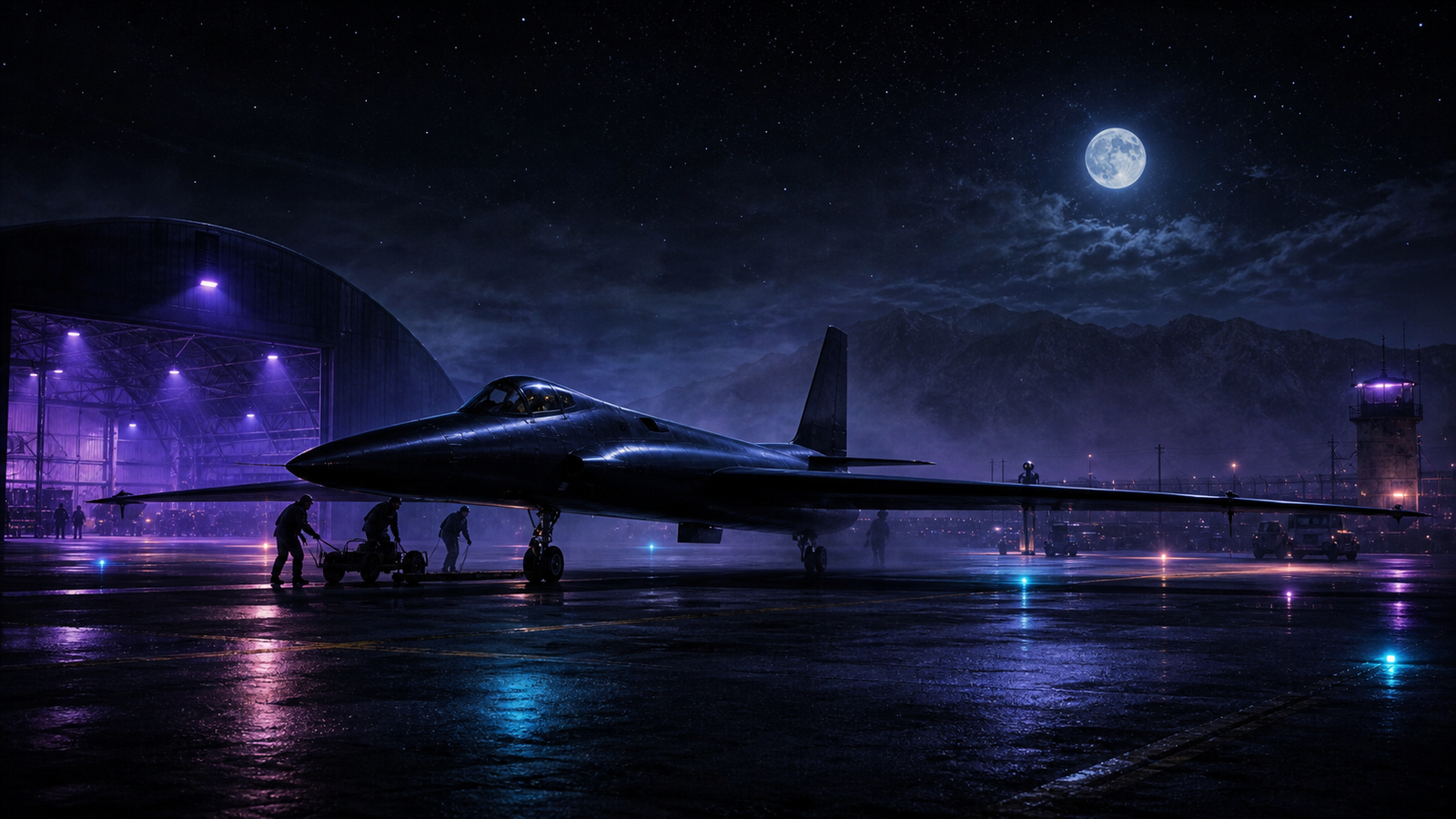
Project Aquatone U-2 Spy Plane Black Program
Project Aquatone mattered because it gave the United States a way to look behind the Iron Curtain when diplomacy, satellites, and conventional air power could not yet do the job.
That is the key.
What Washington wanted was not just another aircraft. It wanted a strategic instrument.
It wanted:
- an airplane that could fly higher than enemy interceptors,
- a camera platform that could turn Soviet claims into measurable reality,
- and a covert operating structure that would let the United States gather that intelligence without openly committing a military act of war.
In that form, Aquatone became more than the development story of the U-2.
It became one of the clearest Cold War black programs in which aerospace design, presidential risk management, covert funding, and strategic intelligence all fused into one system.
That is why it still matters.
It marks the moment when altitude became a method of truth.
The first thing to understand
This is not only an aircraft story.
It is a system-of-deniable-overflight story.
That matters.
The airplane matters, of course. But the U-2 only became historically decisive because it was wrapped in:
- CIA ownership,
- Air Force support,
- private-industry speed,
- secret basing,
- and direct presidential control over the riskiest missions.
That matters because Aquatone was never just metal and wings. It was a covert architecture.
Why 1953 and 1954 matter
The roots of Aquatone lie in the years when the United States knew too little and feared too much.
That matters.
The early 1950s strategic debate was shaped by concern over Soviet long-range bombers, missile development, and the inability of Western intelligence to verify Soviet claims with confidence. The State Department’s U-2 milestone summary notes that by 1955 American leaders were increasingly concerned about the relative nuclear balance and needed better means of verification after the failure of the Open Skies proposal.
That matters because Aquatone was born from uncertainty.
The program was the answer to a question that intelligence estimates alone could not settle: what was really happening inside Soviet strategic territory?
Kelly Johnson and the CL-282
The first answer came from Lockheed.
That matters.
Lockheed’s Clarence “Kelly” Johnson sketched the original design concepts in 1953. Lockheed’s own historical summary and NASA’s detailed U-2 design history both place Johnson and the CL-282 at the beginning of the aircraft’s story.
That matters because the technical concept was radical enough to look fragile:
- long glider-like wings,
- a stripped-down lightweight airframe,
- and altitude prioritized above almost everything else.
The design was not trying to win a dogfight. It was trying to sit above one.
Why the CIA took control
This is one of the deepest truths of the entire program.
That matters.
Official NRO history states that President Eisenhower believed the overflight had to be conducted as a classified operation, and that if uniformed U.S. military personnel flew over Russia it would legally constitute an act of war. The same history says a joint Air Force-CIA team therefore developed the U-2 under Project Aquatone.
That matters because CIA ownership was not a bureaucratic accident. It was legal and political camouflage.
The aircraft had to exist in a shadow zone: American, state-sponsored, strategic, but not overtly military in presentation.
Richard Bissell and the making of the program
If Kelly Johnson gave Aquatone its airframe, Richard Bissell gave it its operating shape.
That matters.
NASA’s U-2 history states that on November 26, 1954, Allen Dulles assigned Bissell to take charge of the CL-282 development effort, designated Project Aquatone. It also notes that Bissell quickly moved to obtain CIA contingency funding and divert needed Air Force materiel into the project under conditions of extreme secrecy.
That matters because Aquatone was as much an administrative feat as an engineering one.
Bissell turned a promising airplane into a functioning black program.
The Air Force role
CIA ownership can make readers forget how essential the Air Force was.
That matters.
NASA’s history says Colonel Osmond J. Ritland was assigned as Air Force liaison and worked closely with Bissell. It notes that Air Force-procured J57 engines were diverted into the program to protect secrecy and accelerate development.
That matters because Aquatone was not CIA-versus-Air-Force. It was CIA cover plus Air Force muscle.
The black-program magic was in the combination.
Why the funding mattered
The program moved fast because its money moved differently.
That matters.
The National Security Archive’s 2013 overview of newly declassified U-2 material notes that Bissell used CIA unvouchered funds to keep the program alive and move quickly, including an immediate $1.25 million check to Kelly Johnson while the larger contract was being formalized.
That matters because black programs often depend on speed made possible by secrecy. Aquatone was one of the clearest examples.
Groom Lake / Area 51
Aquatone also mattered because it gave a famous place one of its first real historical missions.
That matters.
NASA’s history states that in April 1955 Johnson, Bissell, and Ritland inspected the dry lakebed adjacent to the Atomic Energy Commission’s Nevada test site and selected it for final assembly and testing. It further states that the CIA had overall control of the program at the site. The National Security Archive later highlighted the same declassified history as one of the first official acknowledgments of Groom Lake / Area 51 as a real location in the U-2 story.
That matters because Groom Lake was not born as UFO folklore. It was born as intelligence infrastructure.
Why Groom Lake was ideal
The site solved several problems at once.
That matters.
It was remote enough to hide the aircraft’s unusual appearance and performance, yet connected enough to support accelerated developmental testing. NASA’s history shows how the lakebed site let the CIA and Lockheed build an isolated world of assembly, flight testing, security, logistics, and cover discipline around the new aircraft.
That matters because Aquatone needed more than a runway. It needed a place where secrecy could be built into the landscape.
The first flights
Lockheed and CIA planners moved with astonishing speed.
That matters.
NRO history says Lockheed built the first aircraft in eight months. NASA’s history tracks the developmental test phase in summer 1955, when Tony LeVier and other test pilots pushed the aircraft into its first real performance envelope at Groom Lake.
That matters because Aquatone was not a leisurely development program. It was a compressed emergency architecture for strategic intelligence.
The deceptive designation
Even the aircraft’s name was part of the cover.
That matters.
NASA’s U-2 history states that the final configuration received the deliberately misleading designation U-2, with the “U” standing for a vague utility category rather than a clear reconnaissance label.
That matters because black programs hide not only where they operate and who funds them, but also what they are called.
The first operational overflight
The aircraft became historically decisive when it crossed Soviet airspace.
That matters.
Official NRO history states that the first mission was flown on July 4, 1956. The State Department’s U-2 milestone page likewise notes that the first flight over Moscow and Leningrad took place on July 4, 1956, and that the flights continued intermittently over the next four years. CIA’s “Russian officer remembers” article similarly places the first overflights on July 4, 1956 and describes them as the opening of a new stage of strategic reconnaissance.
That matters because this is the moment the program stops being experimental and starts changing history.
What the flights actually found
This is where Aquatone earned its place.
That matters.
The Smithsonian’s U-2 history says the overflights revealed that the supposed “missile gap” did not exist in the exaggerated form Soviet propaganda suggested. It also notes that the flights gathered vital information on Soviet strategic military capabilities. CIA’s Russian-officer retrospective similarly describes how early U-2 photography showed that Soviet strategic bomber production was much more modest than feared and helped identify missile test and deployment activity.
That matters because Aquatone attacked uncertainty directly.
The program did not just collect pictures. It corrected national estimates.
Why the bomber gap mattered
The “bomber gap” was more than a slogan.
That matters.
In the mid-1950s, U.S. officials worried that Soviet long-range bomber numbers and readiness might exceed American assumptions. The early U-2 missions provided evidence that these fears were exaggerated. That intelligence changed both strategic debate and procurement logic.
That matters because Aquatone’s cameras were not decorative. They influenced force structure and national policy.
Missile intelligence
The U-2 was just as important for missiles.
That matters.
CIA’s Russian-officer account states that U-2 photography identified key missile activity, including work at Kapustin Yar and the Tyuratam intercontinental-missile site. The National Security Archive’s summary of the newly declassified CIA history also highlights 1957 U-2 photography of an R-7 missile launch pad at Tyuratam.
That matters because missile intelligence was one of the reasons Aquatone was worth the political risk.
The cover story
A black aircraft also needs a public-facing identity.
That matters.
NASA’s U-2 history explains that NACA-related research cover arrangements were part of the program’s public camouflage. It also notes internal concern that scientific-publication patterns had to support the cover story in case an aircraft was compromised.
That matters because Aquatone did not rely on invisibility. It relied on misdirection.
CHALICE and IDEALIST
Project Aquatone also mattered because it evolved.
That matters.
The National Security Archive’s “Science, Technology and the CIA” summary notes that the CIA-Air Force program first known as AQUATONE later continued under other operational names, including CHALICE and IDEALIST.
That matters because Aquatone was the beginning of a lineage, not a single frozen codename.
The growing risk
Aquatone’s success created its own deadline.
That matters.
Official NRO history notes that it became clear relatively early that improving Soviet air defenses would eventually make U-2 overflights too risky. CIA’s Russian-officer retrospective describes the growing effectiveness of Soviet radar, interceptors, and especially the SA-2 system by the late 1950s.
That matters because black programs built around temporary technical superiority carry an expiration date. Aquatone’s was visible before 1960.
Francis Gary Powers and the break
The break came on May 1, 1960.
That matters.
NRO history states that after 24 successful missions, CIA pilot Francis Gary Powers was shot down near Sverdlovsk by an SA-2 missile. The State Department milestone history says the incident caused a major diplomatic crisis and helped wreck the Paris Summit.
That matters because one missile exposed the contradiction at the center of Aquatone: a system designed to reduce uncertainty through covert violation of sovereignty.
Why the Powers incident was so damaging
The problem was not only that the aircraft was lost.
That matters.
It was that Powers survived. The Soviet Union recovered major evidence. And the U.S. weather-flight cover story collapsed almost immediately. The State Department summary shows how this exposed American deceit publicly and forced Eisenhower to acknowledge his personal approval of the program.
That matters because Aquatone had always depended on plausible deniability. On May 1, 1960, that deniability broke.
What Aquatone changed
Even after the overflights ended, the program’s deeper legacy remained.
That matters.
CIA’s official U-2 history says the manned reconnaissance program changed the CIA’s work and structure in ways that were “revolutionary and permanent,” including helping drive the creation of the Directorate of Science and Technology.
That matters because Aquatone did not just produce intelligence. It helped reconfigure the institutions of intelligence.
The path to satellites and successors
Aquatone also helped push the United States toward other overhead systems.
That matters.
NRO history notes that as U-2 overflights became riskier, U.S. officials looked for alternatives, including both a faster, higher aircraft and orbiting satellites.
That matters because Aquatone was a bridge program: from aircraft overflight to a wider age of overhead intelligence.
That makes its success and vulnerability equally important.
What the strongest public-facing record actually shows
The strongest public-facing record shows something very specific.
It shows that Project Aquatone was the covert CIA-Air Force program that developed the U-2 under Kelly Johnson’s design leadership and Richard Bissell’s CIA management; that Eisenhower insisted the aircraft be operated covertly through the CIA because overt military overflight would amount to an act of war; that Groom Lake became the hidden developmental site in 1955; that the first operational overflight of the Soviet Union took place on July 4, 1956; that the aircraft’s photography helped debunk exaggerated fears about Soviet bomber and missile strength while revealing key Soviet strategic facilities; and that the program’s deep-overflight phase ended in political disaster when Francis Gary Powers was shot down over Sverdlovsk on May 1, 1960.
That matters because it gives Aquatone its exact place in history.
It was not only:
- the U-2’s backstory,
- a Groom Lake prelude,
- or a CIA aviation project.
It was the black program that made strategic overflight real.
Why it matters in this encyclopedia
This entry matters because Project Aquatone U-2 Spy Plane Black Program explains how the United States learned to substitute altitude and secrecy for certainty and trust.
Instead of waiting for Soviet transparency, it built a plane to photograph around it.
Instead of sending uniformed aircraft openly, it hid the program inside CIA ownership.
Instead of relying on estimates alone, it made the camera the instrument of strategic correction.
That matters.
Project Aquatone is not only:
- a U-2 page,
- a Kelly Johnson page,
- or an Area 51 page.
It is also:
- a bomber-gap page,
- a missile-gap page,
- a deniability page,
- a Groom Lake page,
- and a black-program transformation page.
That makes it one of the strongest foundation entries in the archive.
Frequently asked questions
What was Project Aquatone?
Project Aquatone was the covert CIA-Air Force program that developed and operated the U-2 high-altitude reconnaissance aircraft in the 1950s.
Was Project Aquatone a real black program?
Yes. CIA, NRO, NASA, State, and National Security Archive sources all firmly establish Aquatone as a real covert development and overflight program.
Why did the CIA run the program instead of the Air Force?
Because Eisenhower believed overt military overflight of Soviet territory would be tantamount to an act of war, so CIA cover provided political and legal deniability.
Who led the program?
Richard Bissell ran Aquatone for the CIA, while Kelly Johnson led the aircraft design effort at Lockheed and Osmond Ritland served as the key Air Force liaison.
Was Groom Lake really part of the U-2 story?
Yes. Groom Lake was selected in 1955 as the secure site for assembly, testing, and development of the U-2.
When did the first Soviet overflight happen?
The first operational overflight of the Soviet Union took place on July 4, 1956.
Why was the U-2 so important?
Because it provided direct intelligence on Soviet bomber production, missile testing, air defenses, and other strategic systems at a time when the United States lacked better ways to verify them.
Did the U-2 really affect the “missile gap” debate?
Yes. U-2 intelligence helped show that Soviet strategic capability was not as overwhelming as many American fears and Soviet claims suggested.
What ended the program’s overflight phase?
The key turning point was the May 1, 1960 shootdown of Francis Gary Powers near Sverdlovsk by an SA-2 missile.
What is the strongest bottom line?
Project Aquatone matters because it created the covert U-2 overflight system that replaced strategic guesswork with photography and, in doing so, transformed Cold War intelligence.
Related pages
- Black Projects
- Program 437 Thor Anti-Satellite Black Program
- Program 621B Early GPS Navigation Satellite Program
- Operation Starfish Prime High Altitude Nuclear Test
- Project Aquacade Signals Intelligence Satellite Program
Suggested internal linking anchors
- Project Aquatone U-2 spy plane black program
- Project Aquatone
- AQUATONE U-2 history
- CIA U-2 development program
- Aquatone Kelly Johnson
- Aquatone Groom Lake history
- first U-2 Soviet overflight
- declassified Project Aquatone history
References
- https://www.cia.gov/resources/csi/books-monographs/the-cia-and-the-u-2-program-1954-1974/
- https://www.cia.gov/resources/csi/static/CIA-and-U2-Program.pdf
- https://www.nro.gov/Portals/65/documents/history/csnr/programs/NRO_Brief_History.pdf
- https://www.nro.gov/Portals/65/documents/foia/docs/foia-nro-history.pdf
- https://www.nasa.gov/wp-content/uploads/2015/07/unlimited-horizons.pdf
- https://nsarchive2.gwu.edu/NSAEBB/NSAEBB434/
- https://nsarchive2.gwu.edu/NSAEBB/NSAEBB54/
- https://history.state.gov/milestones/1953-1960/u2-incident
- https://www.cia.gov/resources/csi/studies-in-intelligence/archives/vol-42-no-5/the-u-2-program-a-russian-officer-remembers/
- https://airandspace.si.edu/stories/editorial/high-flying-spy-plane
- https://airandspace.si.edu/collection-objects/lockheed-u-2c/nasm_A19820380000
- https://www.lockheedmartin.com/en-us/news/features/history/u2.html
- https://www.cia.gov/resources/csi/studies-in-intelligence/studies-in-intelligence-winter-1998-1999/the-u-2-program-the-dcis-perspective/
- https://www.nro.gov/Portals/135/documents/history/csnr/NRO_History_in_Photos_7May2024_web.pdf
- https://www.cia.gov/readingroom/docs/DOC_0000192682.pdf
Editorial note
This entry treats Project Aquatone as one of the most important aircraft-development files in the entire black-projects archive.
That is the right way to read it.
Aquatone matters because it shows what happens when a state needs an answer badly enough to invent not only a new airplane, but a new legal and organizational shell around the airplane. The U-2 did not emerge as a normal Air Force procurement. It emerged as a covert intelligence instrument disguised through CIA ownership, accelerated by unvouchered money, protected by a desert test site, and flown under conditions of presidentially managed deniability. That is the deeper significance of the file. Aquatone was not just a remarkable machine; it was a method for turning strategic uncertainty into photography while postponing the full diplomatic consequences of how that photography was obtained. Its success helped puncture exaggerated fear of Soviet capabilities and changed American intelligence permanently. Its failure in 1960 showed the political cost of violating sovereignty from above even when the information payoff was immense. That tension is what gives Project Aquatone its long shadow. It is the black program that made altitude into intelligence power.