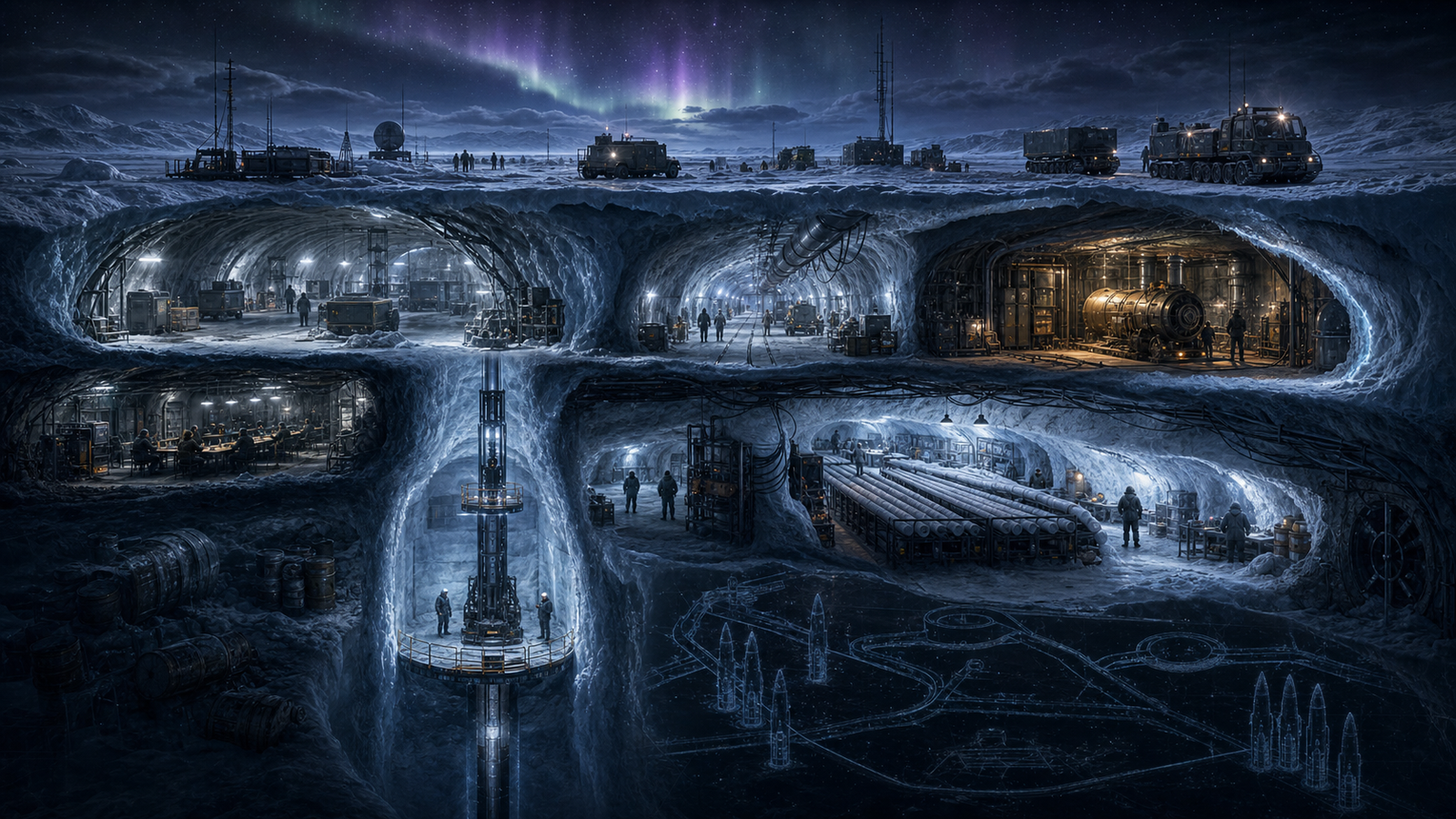
Camp Century Arctic Tunnel Base Black Program
Camp Century mattered because it was both a real Arctic city and a test for something larger.
That is the key to the whole site.
Built into the Greenland ice sheet by the U.S. Army Corps of Engineers, Camp Century was publicly presented as a research and engineering outpost: a demonstration that people could live, work, generate power, manage utilities, and conduct science inside a tunnel system cut into polar snow and firn.
That public description was true.
But it was not the whole truth.
Camp Century also mattered because it was the practical feasibility platform for Project Iceworm, the far more ambitious idea of hiding a large, mobile nuclear missile network under the Greenland ice. That secret strategic purpose gave the camp a second meaning: what looked like an Arctic engineering experiment was also a test of whether a glacier could be militarized into infrastructure.
The strongest public record supports both of those realities. Camp Century was a real under-ice base with real scientific work, real reactor operations, and real engineering data. It was also part of a larger hidden strategic dream that never became operational. That combination makes it one of the most revealing Cold War black programs in the Arctic record.
Quick profile
- Topic type: historical record
- Core subject: how Camp Century served as both a real under-ice Army base and a feasibility platform for Project Iceworm
- Main historical setting: 1958 to 1967, with major scientific and environmental afterlife extending into the present
- Best interpretive lens: not “was Camp Century secret,” but “how did a public Arctic base also function as a hidden strategic infrastructure test”
- Main warning: Camp Century was real and important, but it was never itself the full Iceworm missile network
What this entry covers
This entry is the headline page for the Camp Century cluster in the black-projects archive.
It covers:
- why the Army built the camp,
- how the under-ice trench city worked,
- why the PM-2A portable nuclear reactor mattered,
- how Camp Century connected to Project Iceworm,
- why the ice itself eventually defeated the concept,
- how the camp produced a major climate-science legacy through deep ice cores,
- why abandonment created a later environmental problem,
- and how radar rediscovery gave the buried base a second public life.
That matters because Camp Century is not only a black-projects base page. It is also:
- an Arctic engineering page,
- a portable nuclear systems page,
- a missile-feasibility page,
- and a science-from-secrecy page.
Why the Army wanted Camp Century
Camp Century was built because the Arctic looked militarily useful and politically unfinished.
That is the larger Cold War context.
Greenland’s location made it strategically attractive as a northern platform between the United States and the Soviet Union. If military infrastructure could be placed deeper into the ice sheet, it might provide survivable positions for command, logistics, or even missile deployment.
But the Army first had to answer a more basic question: could a permanent under-ice base actually work?
Camp Century was the test.
The under-ice city concept
The camp used a cut-and-cover trench method.
Parallel trenches were excavated into the near-surface layers of the ice sheet, arched over, and then covered so that prefabricated buildings, utility lines, storage areas, workshops, and living spaces could exist below the surface in a more protected environment. CRREL’s 1965 technical history says the layout was designed as a series of parallel main trenches linked by a main vehicular access trench, and that the facilities were meant to include living quarters, a kitchen and mess hall, showers and latrines, a recreation hall and theater, library and hobby shops, a dispensary and infirmary, a laundry, a post exchange, scientific laboratories, cold storage, a communications center, equipment shops, and a chapel. :contentReference[oaicite:1]{index=1}
That matters because Camp Century was not just a bunker. It was an entire systems experiment in Arctic habitation.
Construction and scale
Actual camp construction began in June 1959 and was completed in October 1960, according to the 1965 CRREL report. The same report treats Camp Century as a real proof-of-concept for subsurface ice-cap camps and notes that its main engineering objectives were achieved. :contentReference[oaicite:2]{index=2}
NASA’s 2024 Earth Observatory summary says the Army Corps built the base in 1959 by cutting a network of tunnels into the near-surface ice sheet, and that after abandonment the structures were buried under accumulating snow and ice to a depth of at least 30 meters (100 feet). :contentReference[oaicite:3]{index=3}
That matters because the camp was substantial enough to leave a long-lived buried infrastructure field visible in radar decades later.
The PM-2A portable nuclear reactor
One of the most important things about Camp Century was its PM-2A reactor.
CRREL records show that the Army approved the PM-2A path in 1959, that ALCO Products got the fabrication contract in February of that year, and that the reactor arrived and was installed during the 1960 construction phase. The same report says the PM-2A operated from 1960 until 9 July 1963, after which it was shut down pending relocation and later removed as seasonal operation made continued reactor use impractical. :contentReference[oaicite:4]{index=4}
That matters because Camp Century was not just a trench camp with generators. It was one of the clearest demonstrations of portable nuclear power for a remote military facility.
This also made the camp feel futuristic even in its own time. It looked less like an outpost and more like a model of how the Army imagined sustaining extreme remote infrastructure in the atomic age.
Why nuclear power mattered to the larger concept
The PM-2A reactor mattered because Project Iceworm would have been impossible without solving power and logistics at scale.
A hidden under-ice missile system needed:
- electricity,
- heat,
- water,
- communications,
- transport support,
- and a way to reduce the logistic burden of supplying a base deep inside the Greenland ice sheet.
CRREL’s own conclusions say modular semi-portable nuclear power plants were feasible and practical for remote military facilities as large as or larger than Camp Century. :contentReference[oaicite:5]{index=5}
That matters because Camp Century was testing not just life under the ice, but whether under-ice military infrastructure could become self-sustaining enough to matter strategically.
Project Iceworm: the hidden strategic layer
The larger hidden program behind Camp Century was Project Iceworm.
The 2016 Camp Century climate paper states that the project envisioned a subsurface railway beneath roughly 1.3 × 10^5 square kilometers of the Greenland ice sheet to support 600 ballistic missiles. The CIRES summary translates the concept more plainly as a proposed 4,000-kilometer tunnel system capable of deploying up to 600 nuclear missiles. :contentReference[oaicite:6]{index=6}
That matters because Camp Century was the feasibility site for one of the most extreme Arctic strategic concepts of the Cold War: a moving missile network hidden beneath ice and, in theory, better able to survive a first strike.
Camp Century itself was not that network. But it was the place where the Army learned whether the basic physical idea could survive contact with the ice.
Why the ice defeated the dream
The strongest engineering lesson of Camp Century was brutal and simple: the ice moved too much.
CRREL’s 1965 report devotes major attention to trench deformation and the loss of vertical and horizontal clearance. It also documents continuing snow trimming, structural adjustments, and portal problems. The program’s own engineering history concludes that subsurface camps were feasible, but only with constant attention to snow creep and deformation. :contentReference[oaicite:7]{index=7}
Later summaries are even clearer. The idea of a huge missile network under the Greenland ice failed because the glacier was not a stable foundation. It was a slow-moving, deforming medium.
That matters because the failure was not primarily one of imagination. It was one of glaciology.
Continuous occupation, seasonal decline, and abandonment
The 2021 firn-evolution paper says Camp Century was built in 1959, continuously occupied until 1964, and then operated in additional seasonal form until abandonment in 1967. :contentReference[oaicite:8]{index=8}
That matters because the camp did not vanish the moment Iceworm became unrealistic. It lingered. It still had engineering and scientific value even after the larger strategic vision had collapsed.
But the logic had changed. By the time the base was finally abandoned, it was no longer a plausible model for the much larger under-ice network it had been meant to support.
The scientific legacy: Camp Century and the deep ice core
One of the most important unintended consequences of Camp Century was its role in ice-core science.
The Niels Bohr Institute notes that in 1964 Willi Dansgaard visited Camp Century and learned that CRREL was drilling through the Greenland ice cap there. The institute describes the resulting Danish-American collaboration on isotope analysis as a major beginning for later Greenland ice-core science. :contentReference[oaicite:9]{index=9}
The 2024 Cryosphere paper says the last of three Camp Century cores, drilled between 1963 and 1966, recovered about 3.5 meters of subglacial material from beneath the ice sheet. Campcentury.org adds that on July 2, 1966, the drillers penetrated the ice sheet and continued into the frozen ground below. :contentReference[oaicite:10]{index=10}
That matters because Camp Century became one of the first major Greenland deep ice-core sites and helped open an entire climate-science archive that outlived the base itself.
A black program that became a climate archive
This is one of the reasons Camp Century is so historically unusual.
Many black programs disappear into dead ends. Camp Century did not.
Its military future failed, but its scientific afterlife expanded. The site produced a climate archive, an ice-core collaboration history, and now even a rediscovered subglacial sediment record with major implications for Greenland’s long-term environmental history. :contentReference[oaicite:11]{index=11}
That matters because Camp Century is one of the clearest examples of a military black-program site becoming more important to science than to war.
The environmental afterlife
Camp Century also gained a second public life because of what was left behind.
The 2016 AGU paper argued that a transition from net snow accumulation to net ablation could eventually remobilize wastes buried at the site under a high-emissions scenario. NASA’s 2017 Earth Observatory piece visualized the buried physical waste in radar data and described how the debris field sits around 30 meters below the surface. :contentReference[oaicite:12]{index=12}
That concern became politically sensitive because Camp Century had been abandoned with the assumption that continued snowfall would entomb the remains indefinitely.
The 2021 update: still buried through 2100
Later work revised the near-term risk.
The 2021 Frontiers paper says the upper horizon of the debris field, observed at 32 meters depth in 2017, will continue to be buried by persistent net accumulation under all modeled emissions scenarios through 2100, reaching roughly 58 to 64 meters depth by century’s end. :contentReference[oaicite:13]{index=13}
That matters because the environmental story changed from “exposure may come soon” to “buried debris likely remains deeper through this century,” even though the long-term legacy issue does not disappear.
The 2024 radar rediscovery
In 2024, NASA Earth Observatory published a new radar view showing structural elements of Camp Century beneath the Greenland ice.
That matters because it gave the buried base a renewed visual reality. Camp Century stopped being only an archival Cold War story and became, again, a mapped physical structure under the ice. NASA describes the site as a “city under the ice” whose solid structures still lie buried below the accumulating snowpack. :contentReference[oaicite:14]{index=14}
This rediscovery also reinforced something important about the camp: it was not a rumor. It was a real engineered landscape that the ice never entirely erased.
Why this belongs in the black-projects section
This page belongs in declassified / black-projects because Camp Century sits at the intersection of:
- Arctic military infrastructure,
- portable nuclear logistics,
- hidden missile feasibility planning,
- and scientific work conducted inside a semi-secret strategic environment.
It is not conspiracy lore. It is real systems history with a concealed strategic layer.
That makes it one of the strongest historical infrastructure entries in the archive.
What the strongest public record actually supports
The strongest public record supports this narrower conclusion:
Camp Century was a real U.S. Army under-ice base built in Greenland beginning in 1959 to test Arctic construction techniques, utilities, habitability, and portable nuclear power in a trench-and-arch tunnel system beneath the ice sheet. It was also the feasibility platform for Project Iceworm, the larger secret plan to deploy a vast mobile missile network under Greenland’s ice. The PM-2A reactor operated from 1960 to 1963, the camp continued in reduced form until 1967, and the moving ice ultimately made long-term expansion impractical. The site left a major scientific legacy through deep ice-core drilling and a later environmental legacy through buried waste, while modern radar imaging has re-identified its structures beneath the ice.
That is the right balance.
It preserves Camp Century as both an engineering base and a black-program node without confusing it with the larger system it was meant to test.
Why it matters in this encyclopedia
This entry matters because Camp Century Arctic Tunnel Base Black Program explains how Cold War military infrastructure could be at once:
- public,
- secret,
- experimental,
- strategic,
- and scientifically transformative.
It is not only:
- a Camp Century page,
- a Greenland page,
- or a Project Iceworm page.
It is also:
- a reactor-support page,
- an under-ice engineering page,
- a missile-feasibility page,
- and a military-science crossover page.
That makes it one of the most important Arctic bridge entries in the black-projects cluster.
Frequently asked questions
Was Camp Century a real base?
Yes. Camp Century was a real U.S. Army under-ice base in Greenland, built beginning in 1959 and operated until 1967.
Was Camp Century the same thing as Project Iceworm?
No. Camp Century was the real base and engineering test platform. Project Iceworm was the larger hidden missile-network concept for which Camp Century served as a feasibility site.
Why was Camp Century powered by a reactor?
Because the Army needed to test whether a remote under-ice base could be sustained with portable nuclear power and reduced fuel burden.
What was the PM-2A?
It was a portable Army nuclear reactor installed at Camp Century and operated from 1960 until July 1963.
Why did Camp Century fail as a long-term military base model?
Because the Greenland ice sheet deformed continuously, narrowing trenches and making the idea of a large permanent under-ice network impractical.
Why is Camp Century important to climate science?
Because the camp’s drilling operations produced one of the first major deep Greenland ice cores, and the site’s recovered subglacial material remains scientifically important today.
Is Camp Century still there?
Yes, in buried form. The structures remain entombed beneath accumulating snow and ice and have been imaged by modern radar.
Is the waste from Camp Century about to emerge?
The 2016 study raised concern under strong warming scenarios, but the 2021 firn-evolution work indicates the debris field will remain buried deeper through 2100.
What is the strongest bottom line?
Camp Century mattered because it proved that an under-ice military city could be built, showed why a much larger missile network beneath Greenland would not work, and accidentally produced one of the most important scientific archives in Arctic climate history.
Related pages
- Project Iceworm Greenland Under-Ice Missile Program
- Project GREEK ISLAND Greenbrier Continuity Bunker Program
- Operation LOOKING GLASS Airborne Command Post Program
- Operation NIGHT WATCH Presidential Doomsday Aircraft Program
- SNAP Space Nuclear Power Program
- SP-100 Space Reactor Black Program
- Project HORIZON Army Lunar Outpost Program
- Project LUNEX Air Force Moonbase Program
- Queen Maud Land Subglacial Black Project Conspiracy
- Lake Vostok Ancient Contact Facility Theory
- Antarctica Hidden Nazi Alien Base Conspiracy
- Black Projects
Suggested internal linking anchors
- Camp Century Arctic tunnel base black program
- Camp Century Greenland under ice base history
- Camp Century Project Iceworm history
- Camp Century PM-2A reactor history
- Camp Century city under the ice
- Camp Century deep ice core history
- Camp Century tunnel deformation failure
- Camp Century environmental legacy Greenland
References
- https://images.derstandard.at/2019/08/23/CampCentury.pdf
- https://commons.wikimedia.org/wiki/File:Construction_of_the_Army_nuclear_power_plant_PM-2A_at_Camp_Century%2C_Greenland-_Final_report_-_USACE-p266001coll1-3968.pdf
- https://science.nasa.gov/earth/earth-observatory/new-view-of-the-city-under-the-ice-153616/
- https://science.nasa.gov/earth/earth-observatory/camp-century-put-on-ice-but-only-for-so-long-89515/
- https://agupubs.onlinelibrary.wiley.com/doi/full/10.1002/2016GL069688
- https://www.frontiersin.org/journals/earth-science/articles/10.3389/feart.2021.578978/full
- https://nbi.ku.dk/english/research/pice/history-of-ice-core-science/
- https://tc.copernicus.org/articles/18/4029/2024/
- https://cires.colorado.edu/news/greenland-and-legacy-camp-century
- https://ahf.nuclearmuseum.org/ahf/history/camp-century/
- https://www.campcentury.org/
- https://pure.au.dk/ws/files/81615219/City_under_the_Ice_2014.pdf
- https://www.researchgate.net/publication/249564008_Cold_War_Under_the_Ice_The_Army%27s_Bid_for_a_Long-Range_Nuclear_Role_19591963
- https://radiationeffects.org/wp-content/uploads/2023/03/A-Look-Back-at-the-Portable-Nuclear-Reactor-that-Sat-on-Top-of-the-World.pdf
Editorial note
This entry treats Camp Century as one of the clearest cases where a real military infrastructure project had two lives at once.
That is the right way to read it.
One life was public: an Arctic research and engineering camp beneath the Greenland ice, powered by a portable reactor and used to test whether a tunnel city in snow could function. The other life was strategic: a feasibility platform for Project Iceworm, the far larger hidden plan to stretch a mobile missile system under the ice sheet. The camp succeeded enough to prove that under-ice habitation and utilities were possible. It failed enough to prove that the glacier itself would not cooperate with permanent strategic architecture. That combination is what makes Camp Century historically important. It was not a fantasy and it was not merely a cover story. It was a real place where engineering ambition, nuclear logistics, Arctic militarization, and climate science all met inside a moving mass of ice.