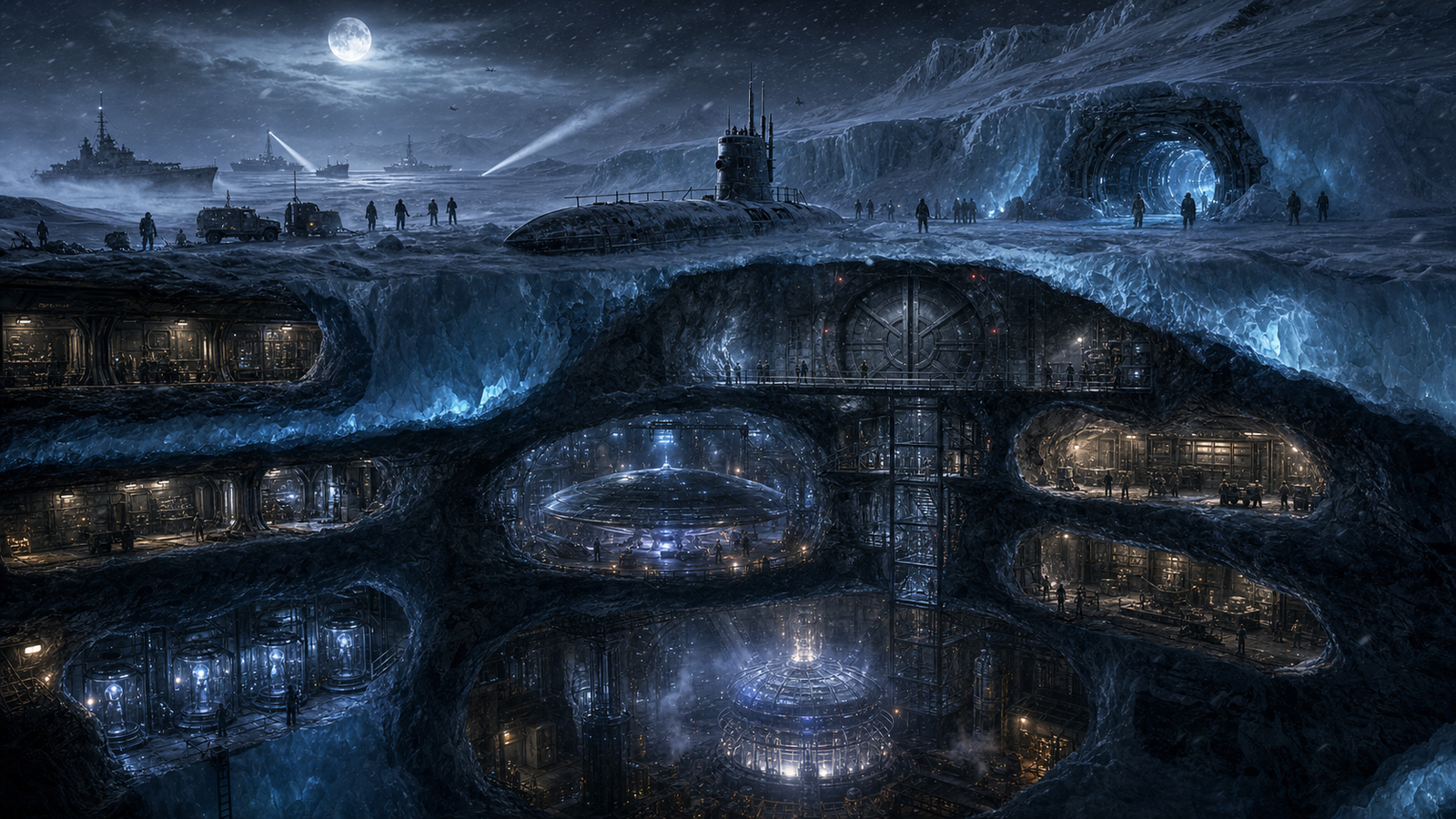
Antarctica Hidden Nazi Alien Base Conspiracy
The Nazi Antarctica story did not begin as an alien-base story.
It became one later.
That is the most important key to the entire myth.
At its core, the theory is built from a real historical fragment: the German Antarctic Expedition of 1938–39. That expedition really happened. It really operated in the region later tied to the name Neuschwabenland in Queen Maud Land. It really gave the story a map, a ship, an official mission, and a moment in history that conspiratorial imagination could keep returning to.
But the famous version of the story is larger than the expedition.
It adds:
- an under-ice fortress,
- U-boat escape corridors,
- a surviving Reich command center,
- occult continuity,
- hidden aircraft or saucers,
- and eventually aliens.
That is why this conspiracy became so durable. It was not one myth. It was a fusion myth.
The strongest public record supports the expedition, the later mythmaking, and the long afterlife of polar secrecy fantasies. It does not support the existence of a verified Nazi alien base beneath the Antarctic ice.
Quick profile
- Topic type: conspiracy theory
- Core subject: how the real German Antarctic expedition became the modern myth of a hidden Nazi alien base under the ice
- Main historical setting: from the 1938–39 Neuschwabenland expedition through postwar U-boat and Highjump legends, occult-Nazi reinterpretations, and UFO-era alien overlays
- Best interpretive lens: not “where is the base,” but “how did Antarctic expedition history become an under-ice Reich-and-alien super-myth”
- Main warning: the real expedition is historical fact; the hidden Nazi alien base is not historically demonstrated
What this entry covers
This entry is the broadest headline page for the Nazi Antarctica cluster in the black-projects archive.
It covers:
- the real 1938–39 German expedition,
- why Neuschwabenland matters,
- what the expedition actually did,
- how the under-ice-base myth formed,
- why Operation Tabarin and Operation Highjump were later pulled into the story,
- how the Argentina U-boat narratives amplified survival fantasies,
- why Hollow Earth and esoteric Nazism reshaped the myth,
- and how a hidden polar Reich later became a UFO and then alien-base theory.
That matters because most retellings compress all of these layers into one seamless narrative. Historically, they were added over time.
The real core: the German Antarctic Expedition of 1938–39
The real historical core of the myth is the German Antarctic Expedition of 1938–39 under Alfred Ritscher aboard the Schwabenland.
This is where the story gains its legitimacy.
The expedition explored part of Dronning Maud Land, later associated with the German name Neuschwabenland. Its motives were tied to a mixture of resource strategy, whaling interests, mapping, and territorial positioning in the late 1930s.
That matters because the strongest scholarship does not describe this as a wartime construction project for a giant hidden base. It describes a real polar expedition with political and economic dimensions, not a documented under-ice fortress program.
This is the first distinction that always gets blurred.
A real expedition is the seed. The base is the myth that grew around it.
Why Neuschwabenland became such a powerful anchor
Conspiracies last longer when they can point to a real name on a map.
Neuschwabenland gave the Antarctica story exactly that.
A vague hidden kingdom is easier to dismiss. A named region tied to an actual expedition feels harder to shake. It sounds like evidence even when the later conclusions do not follow.
That matters because many powerful conspiracy stories work by attaching extraordinary claims to ordinary historical anchors.
In this case the anchor is strong:
- a real expedition,
- a real leader,
- real aerial photography,
- real Antarctic geography,
- and a real place-name.
That was enough to let later writers imagine the rest.
What the expedition did not prove
This point is essential.
The expedition did not prove:
- a permanent wartime city,
- an underground hangar complex,
- a Reich redoubt,
- a functioning polar submarine dock,
- or a hidden alien facility.
The strongest historical work is explicit that later sensational claims about a Nazi base in Antarctica are myths layered onto the expedition, not straightforward deductions from it.
That matters because the myth gets much of its power by pretending the leap from exploration to fortress is smaller than it really is.
It is not a small leap. It is the whole myth.
Why Antarctica was perfect for hidden-base fantasy
Antarctica became the ideal stage for this theory because it is already difficult, remote, cold, and sparsely accessible.
That matters more than it first appears.
A hidden base story needs:
- a place ordinary people cannot easily reach,
- an environment hostile enough to discourage inspection,
- and a map that feels empty enough to absorb imagination.
Antarctica provides all three.
It is almost a natural conspiracy engine.
That is why so many later additions found a home there: not because they were all historically linked, but because the continent itself felt like a blank screen on which hidden continuity could be projected.
Operation Tabarin and the politics of Antarctic occupation
The myth also gained strength because later Antarctic operations were real.
One of the most important was Operation Tabarin, the secret British wartime mission that established bases in Antarctica during World War II.
That matters because once people learn that the British really did run a secret Antarctic operation, it becomes easier for them to imagine that the Germans must have had something equally dramatic or greater there.
But that is not what follows historically.
Tabarin tells us that Antarctic territory, wartime sovereignty, and strategic presence mattered. It does not verify a hidden Nazi super-base. Instead, it shows how quickly real geopolitical activity in Antarctica can be repurposed into later secrecy lore.
The U-boats to Argentina and the myth of survival
The surrender of U-530 and U-977 in Argentina after the war fed the legend enormously.
This is one of the major myth accelerants.
Why?
Because once submarines appear late, far from Europe, after the Reich has already collapsed, they invite questions:
- what were they carrying,
- where had they been,
- whom had they landed,
- and what route had they used?
That matters because the myth does not need definitive answers. It only needs a surviving corridor.
The Argentina U-boat stories created that corridor. They made it feel possible that the war had not ended cleanly, but had instead bled into hidden routes, secret redoubts, and survival networks.
From there, Antarctica became an irresistible destination in the imagination.
Operation Highjump and the myth of a hidden polar war
No postwar event did more to energize the Antarctica base legend than Operation Highjump.
This was a real and very large U.S. Navy Antarctic operation in 1946–47. That alone made it perfect conspiracy fuel.
A military-style Antarctic mission with ships, aircraft, personnel, and a famous polar figure like Richard Byrd feels like the setup for a revelation. Later mythmakers exploited exactly that feeling.
In conspiracy culture, Highjump is often rewritten as:
- a secret assault on a Nazi base,
- a failed attempt to destroy a hidden Reich redoubt,
- or even a clash with advanced flying craft emerging from beneath the ice.
That is not what the strongest public record supports.
The historical record supports a large Antarctic development and exploration operation. The hidden-war version is the myth that later attached itself to the operation.
Why Highjump became so central to the legend
Highjump mattered because it supplied the story with aftermath.
The 1938–39 expedition gives the myth a beginning. Highjump gives it a supposed confrontation.
That creates narrative completeness:
- first the Nazis go south,
- then they build,
- then they survive,
- then the Americans go after them,
- then something hidden remains.
That structure is emotionally powerful even when the evidence is not.
This is why Highjump became indispensable to the conspiracy. It turned an expedition story into a postwar survival story.
Hollow Earth gave the myth tunnels and depth
The under-ice Reich story becomes much more vivid once it merges with Hollow Earth lore.
This is where the theory gains infrastructure.
A hidden base on the surface is one kind of claim. A hidden base connected to caverns, geothermal pockets, polar openings, or interior passages is much more adaptable. Now the myth can explain:
- why the base is hard to detect,
- how it could survive under ice,
- how submarines might access it,
- and how aircraft or saucers might emerge from nowhere.
That matters because the original expedition did not provide those things. Hollow Earth mythology did.
It gave the Nazi Antarctica story an underground architecture.
Esoteric Nazism and the Black Sun afterlife
The legend changed again when it was absorbed into esoteric-Nazi and postwar occult-fascist mythmaking.
This is one of the most important transformations.
At this stage, Antarctica is no longer just remote geography. It becomes:
- a sanctuary,
- a hidden continuity zone,
- a site of occult survival,
- and sometimes the seat of a future return.
That matters because esoteric-Nazi writers and later far-right occult currents helped turn Antarctica into more than a military refuge. They turned it into a mythic homeland of survival.
This is also where ideas such as:
- the Black Sun,
- hidden elite lineages,
- polar spiritual centers,
- and secret superior technologies
become easier to attach to Antarctic lore.
In other words, the myth becomes ideological, not only geographical.
When the base became an alien base
The alien overlay comes later.
This is another distinction many retellings collapse.
The earliest Nazi Antarctica stories are mostly about:
- survival,
- hidden bases,
- submarines,
- occult continuity,
- or advanced secret weapons.
The alien-base version emerges when postwar UFO culture merges with older Nazi occult and secret-technology legends. At that point Antarctica can become:
- a saucer hangar,
- a nonhuman contact zone,
- a collaborative base,
- or a place where hidden human and nonhuman technologies overlap.
That matters because once alien technology enters the myth, the under-ice Reich is upgraded from survivor-state to advanced breakaway civilization.
This is the point where the story starts linking naturally to secret-space-program lore.
Why Antarctica works so well for UFO and alien overlays
Antarctica is ideal for UFO myth because it already feels:
- unmapped,
- extreme,
- militarized at times,
- and inaccessible.
That makes it easy to imagine that what is hidden there is not just historical but nonhuman.
The shift is simple:
- first the Nazis hide there,
- then they develop strange technology there,
- then the strange technology becomes saucers,
- then the saucers become alien-linked,
- then the base becomes a joint or inherited facility.
That is the evolutionary path of the myth.
From hidden Reich to breakaway civilization
In its most expanded form, the Antarctica conspiracy stops being only about World War II.
It becomes about continuity outside surface history.
That is where it overlaps with:
- breakaway civilization theories,
- secret-space fleets,
- underground command centers,
- and hidden civilizational branches that supposedly outlived public war, public politics, and public science.
That matters because the under-ice Nazi base is often only the middle layer in a larger system. In some versions it becomes:
- the origin point of secret fleets,
- the refuge from which off-world programs grew,
- or the buried node where alien and human technologies were combined.
At that point, the myth has gone far beyond Antarctica while still needing Antarctica as its dramatic origin.
Why the theory persists
The Antarctica hidden Nazi alien base theory persists because it offers five powerful things at once.
1. A real historical anchor
The 1938–39 expedition really happened.
2. A remote continent
Antarctica already feels inaccessible enough to hide the impossible.
3. A broken ending to the war
U-boats and postwar confusion create emotional space for survival myths.
4. A hidden-technology ladder
Secret weapons can evolve into saucers, then into alien-linked systems.
5. A myth of continuity
The theory promises that defeat did not end power, only moved it elsewhere.
That is a nearly perfect conspiracy structure.
What the strongest public record actually supports
The strongest public record supports this narrower conclusion:
The German Antarctic Expedition of 1938–39 was real and historically important, and later British and American Antarctic operations as well as postwar U-boat surrender stories helped create a fertile environment for mythmaking. Over time, occult, Hollow Earth, esoteric-Nazi, UFO, and secret-space narratives fused those fragments into the story of a hidden Antarctic Nazi base, later upgraded in some versions into an alien-linked under-ice facility. The record strongly supports the history of the myth. It does not support the verified existence of a Nazi alien base beneath Antarctica.
That is the right balance.
It preserves the force of the story without mistaking narrative accumulation for proof.
Why this belongs in the black-projects section
This page belongs in declassified / black-projects because the modern Antarctica myth no longer functions as simple wartime rumor.
It functions as systems mythology.
It now connects:
- hidden bases,
- underground facilities,
- esoteric survival,
- advanced craft,
- U-boat logistics,
- and secret-space expansion.
That makes it one of the strongest bridge nodes in the entire archive.
Why it matters in this encyclopedia
This entry matters because Antarctica Hidden Nazi Alien Base Conspiracy explains how one of the most famous hidden-base myths was built.
It is not only:
- an Antarctica page,
- a Nazi survival page,
- or a UFO page.
It is also:
- a hidden-base page,
- an esoteric-Nazi page,
- a breakaway-civilization page,
- and a black-project myth page.
That makes it one of the core entries of the polar-conspiracy branch.
Frequently asked questions
Was there really a German expedition to Antarctica before World War II?
Yes. The German Antarctic Expedition of 1938–39 under Alfred Ritscher is real historical fact.
Is Neuschwabenland a real place name?
Yes. It is the name associated with the territory explored by the German expedition in Queen Maud Land, and that real naming history helped later conspiracy narratives anchor themselves.
Did the expedition prove there was a hidden Nazi base under the ice?
No. The expedition supports exploration, aerial survey, and territorial interest, not a verified underground fortress or alien facility.
Why is Operation Highjump always mentioned in this conspiracy?
Because it was a large real U.S. Antarctic operation after the war, which later storytellers recast as a secret assault on a surviving Nazi base.
Did U-boats really go to Argentina after the war?
Yes. That happened, and those late surrenders helped fuel survivor-state myths, but they do not by themselves prove an Antarctic route or hidden base.
Where does the alien part of the story come from?
Mostly from later fusions between esoteric-Nazi myths, UFO culture, secret-weapons lore, and black-project storytelling.
Is this basically a Hollow Earth theory?
Partly in later versions. Hollow Earth ideas gave the myth tunnels, caverns, polar openings, and underground geography that the original expedition itself did not provide.
Why does Antarctica attract so many conspiracy theories?
Because it is remote, difficult to access, and already associated with military, scientific, and territorial history, which makes it feel like a plausible hiding place for hidden continuity.
What is the strongest bottom line?
The Antarctica hidden Nazi alien base story is a layered fusion myth built from a real expedition and decades of added secrecy narratives, not a historically verified under-ice Reich or alien installation.
Related pages
- Neuschwabenland Secret Survivor Base Theory
- Queen Maud Land Subglacial Black Project Conspiracy
- Lake Vostok Ancient Contact Facility Theory
- Agartha Command Center Breakaway Civilization Theory
- Mount Shasta Inner Earth Base Conspiracy
- Shambhala Hidden Advanced Base Conspiracy
- Project Horizon Secret Moon Base Conspiracy
- Secret Space Program Luna Command Theory
- Solar Warden Secret Space Fleet Conspiracy
- Dark Fleet Mars Defense Conspiracy
- Project Red Sun Secret Mars Mission Conspiracy
- Deep Space Outpost Command Black Project Lore
- Project Looking Glass Time-Viewing Device Conspiracy
- Project Snowbird Alleged Alien Craft Test Flight Program
- Black Projects
Suggested internal linking anchors
- Antarctica hidden Nazi alien base conspiracy
- Nazi Antarctica alien base theory
- Neuschwabenland hidden base theory
- Queen Maud Land Nazi base conspiracy
- Operation Highjump Nazi base myth
- Antarctica secret Reich base lore
- Nazi UFO Antarctica theory
- Antarctic under ice alien base theory
References
- https://www.cambridge.org/core/journals/polar-record/article/hitlers-antarctic-base-the-myth-and-the-reality/56465FFEA98E416F559C7F02AB20CE19
- https://link.springer.com/book/10.1007/978-3-030-40924-1
- https://www.history.com/articles/hitler-nazi-secret-expedition-antarctica-whale-oil
- https://archive.org/details/deutsche-antarktische-expedition-1938-1939
- https://www.bas.ac.uk/about/history/operation-tabarin/
- https://www.cambridge.org/core/services/aop-cambridge-core/content/view/F9FC9B1BC4313BEE6B6029E445ADD5FF/S0032247400044697a.pdf/united_states_operation_highjump_194647.pdf
- https://www.history.navy.mil/about-us/leadership/director/directors-corner/h-grams/h-gram-047.html
- https://www.ats.aq/e/antarctictreaty.html
- https://www.encyclopedia.com/philosophy-and-religion/other-religious-beliefs-and-general-terms/miscellaneous-religion/hollow-earth
- https://books.google.com/books/about/Black_Sun.html?id=AzYTCgAAQBAJ
- https://www.cambridge.org/core/journals/polar-record/article/further-antarctic-myth/FE306128A9700671894C087CA78DEA3C
- https://www.aaro.mil/Portals/136/PDFs/AARO_Historical_Record_Report_Vol_1_2024.pdf
- https://www.bristol.ac.uk/media-library/sites/geography/migrated/documents/far-side.pdf
- https://www.history.navy.mil/browse-by-topic/exploration-and-innovation/polar-exploration0.html
Editorial note
This entry treats the Nazi Antarctica alien base idea as one of the great fusion myths of modern conspiracy culture.
That is the right way to read it.
The historical core is real but limited: a German expedition, aerial survey, economic and territorial motives, and a named Antarctic region. The mythic expansion came later. Postwar submarine surrender stories opened the emotional possibility of hidden survival. British and American Antarctic operations made the continent feel geopolitically active rather than empty. Hollow Earth mythology supplied caverns, entrances, and under-ice infrastructure. Esoteric-Nazi writing supplied the language of occult continuity. UFO culture supplied advanced craft and alien technology. Secret-space lore then extended the whole structure outward beyond Earth. This is why the theory remains so adaptable. It is not one claim with one source. It is a layered mythology built by repeatedly adding new secrecy systems to an already remote and dramatic place.