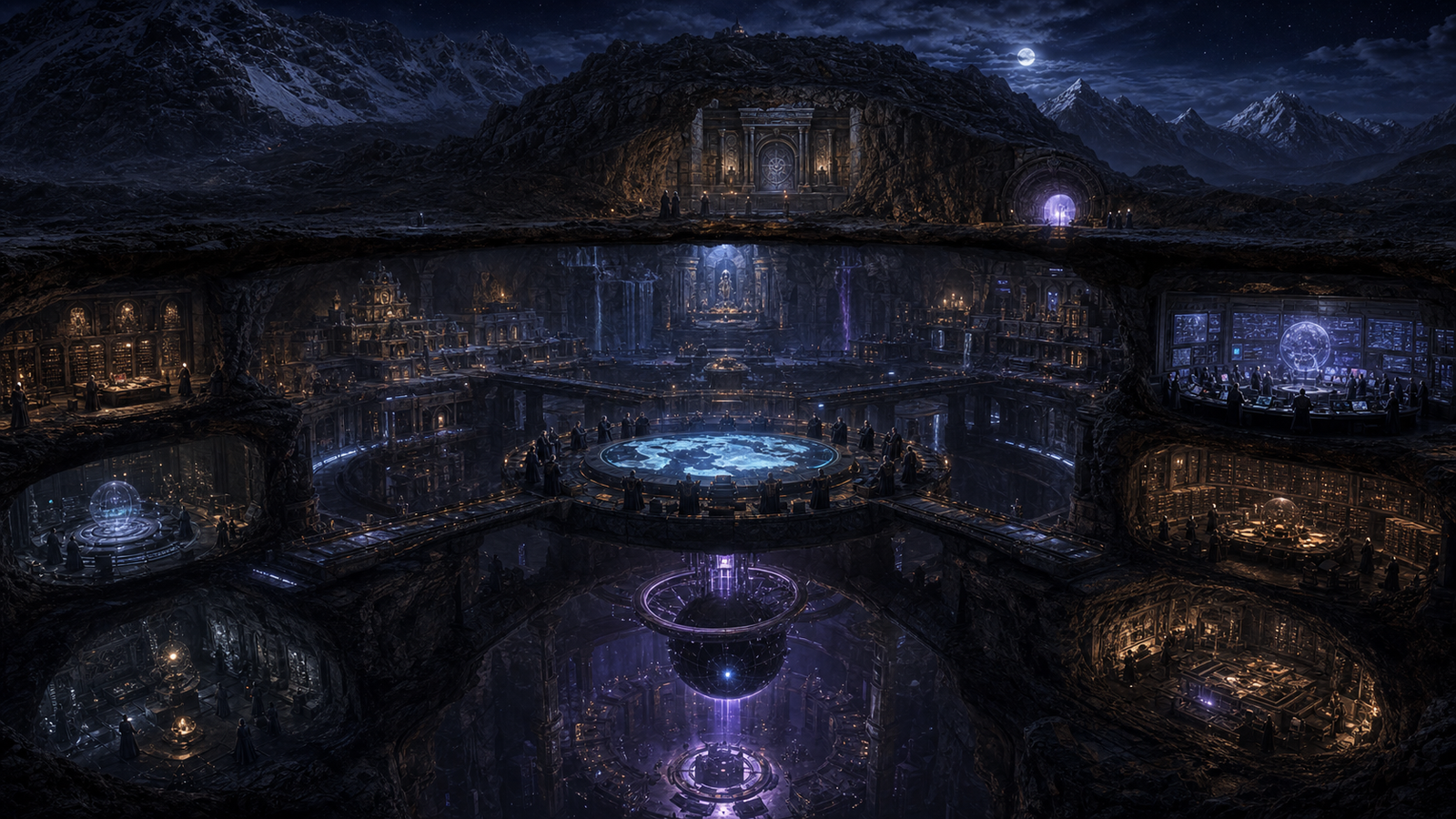
Agartha Command Center Breakaway Civilization Theory
Agartha did not begin as a command center.
It became one later.
That difference matters.
The oldest layers of the Agartha story describe a hidden kingdom, a concealed seat of wisdom, authority, and survival beyond the reach of ordinary history. Only later did conspiracy culture reinterpret that hidden kingdom as something more technical: an underground control node, a strategic refuge, a buried headquarters, or the command architecture of a breakaway civilization.
That is how Agartha changed from mythic geography into black-project-style lore.
The strongest public record does not support the existence of a real subterranean command center governing history from beneath the Himalayas, the poles, or any other hidden entrance network. What it supports is something different and, in a way, more revealing: a myth that kept updating itself to match the secrecy language of each new era.
Agartha first sounded spiritual. Then it sounded occult. Then it sounded hidden. Then it sounded technological. Then it sounded like the headquarters of a civilization that had gone underground and never come back.
That is why it matters.
Quick profile
- Topic type: conspiracy theory
- Core subject: how Agartha was transformed from occult hidden kingdom into a supposed underground command center for a breakaway civilization
- Main historical setting: from late nineteenth-century occult literature through Hollow Earth lore, esoteric-Nazi reinterpretation, and modern secret-space narratives
- Best interpretive lens: not “where is Agartha,” but “why did hidden-kingdom mythology become underground-command-center mythology”
- Main warning: the command-center version is a late synthesis, not the original form of the story
What this entry covers
This entry is the broadest headline page for the Agartha cluster in the black-project conspiracy archive.
It covers:
- the occult origins of Agartha,
- why Saint-Yves d'Alveydre matters so much,
- how Ossendowski popularized the underground kingdom,
- why Guénon turned it into a metaphysical center,
- how Shambhala became tangled into the story,
- why Hollow Earth writers gave it physical depth,
- how far-right and esoteric-Nazi currents changed its meaning,
- and why modern secret-space and breakaway-civilization lore turned it into a command center.
That matters because most present-day Agartha theories combine several incompatible traditions without separating them.
This page does that separation first.
The first layer: not command, but hidden sovereignty
Agartha first becomes important in Western esoteric literature as a story about concealed authority.
That is the oldest useful key.
The myth does not originally work like a military bunker or a modern underground operations room. It works like a hidden center of continuity: a place where wisdom, order, rulership, or primordial knowledge survive while the surface world decays.
That matters because the later command-center reading only makes sense after this older symbolic function is understood.
Agartha is about the idea that the real center of the world is hidden. Everything else comes later.
Saint-Yves and the underground kingdom
The major turning point comes with Alexandre Saint-Yves d'Alveydre and Mission de l'Inde.
This is where Agartha becomes a much more elaborate subterranean polity. Saint-Yves describes a hidden realm associated with extraordinary authority, secret knowledge, and a concealed social order. In his telling, Agarttha is not just lost. It is withdrawn.
That matters because withdrawal is the seed of every later breakaway-civilization version.
A hidden civilization that deliberately retreats underground is already half of the later theory. What modern conspiracy culture adds is the idea that this hidden realm does not merely preserve knowledge. It coordinates events, technology, or influence from below.
That is the command-center upgrade.
Why Shambhala got pulled into the story
A major source of confusion is the relationship between Agartha and Shambhala.
They are often treated as if they were always the same thing. They were not.
Shambhala belongs to a distinct religious and mythic tradition tied to Tibetan Buddhist cosmology. Agartha, as it appears in modern conspiracy and occult literature, is a later Western esoteric construction that borrowed prestige from Asian sacred geography.
That matters because once the two were blended, Agartha gained:
- spiritual legitimacy,
- Himalayan atmosphere,
- hidden-kingdom prestige,
- and a stronger sense of guarded access.
In practice, later writers used Shambhala as a depth charge. It made Agartha feel older, wiser, and more sacred than its actual literary trail suggests.
Ossendowski and the popular underground world
Ferdinand Ossendowski helped move Agartha from specialist occult literature into wider public imagination.
In Beasts, Men and Gods, the hidden realm becomes more vivid, more dramatic, and more accessible to conspiracy-style reading. This is one of the moments when Agartha stops being only a doctrinal or esoteric object and starts to become an adventure narrative.
That matters because adventure narratives are easier to modernize than mystical diagrams.
A hidden kingdom in a travel tale can later become:
- a hidden city,
- a refuge network,
- a technological enclave,
- or a buried command complex.
Ossendowski did not invent the full modern command-center theory. But he helped give the myth its durable underground realism.
Guénon and the center beneath history
With René Guénon, Agartha changes again.
In The King of the World, the hidden realm becomes less like a geographical curiosity and more like a spiritual center behind civilization itself. This is a crucial shift.
A command center is not just a physical place. It is a place from which authority radiates.
Guénon's version gives later conspiracy culture exactly that architecture: a buried center, a hidden hierarchy, and a world-order principle concealed from ordinary people.
That matters because once Agartha becomes the center behind the surface, it becomes easy for later writers to reinterpret it as:
- a hidden governing node,
- a secret council headquarters,
- or the strategic core of a parallel civilization.
Hollow Earth gave Agartha infrastructure
The full underground-command-center version really takes shape once Agartha is merged with Hollow Earth traditions.
This matters more than it first appears.
An occult kingdom is mysterious. A Hollow Earth kingdom gains:
- routes,
- entrances,
- tunnels,
- internal geography,
- and implied logistics.
That transforms the story.
Agartha is no longer just “somewhere hidden.” It now has:
- polar access points,
- cavern networks,
- underground cities,
- and survivable internal space.
Once those elements appear, the myth becomes structurally ready for black-project reinterpretation. It can be pictured as a base.
Why the command center idea appears so naturally
The phrase command center is modern, but it fits Agartha almost too well.
Why?
Because the myth already contains the basic components:
- hidden continuity,
- privileged knowledge,
- inaccessible location,
- superior authority,
- and selective contact with the surface.
All modern conspiracy culture had to do was update the vocabulary.
Instead of a hidden kingdom, it became:
- a subterranean headquarters,
- a hidden archive,
- a continuity government,
- an advanced civilization’s central node,
- or a coordination point for surface manipulation.
This is why Agartha keeps returning whenever people want to explain secret control without visible institutions.
It already feels like the answer before the question is fully formed.
Esoteric-Nazi and postwar transformations
Agartha changed again when it entered the orbit of esoteric-Nazi and postwar occult-fascist mythology.
This is one of the darkest but most important turns in the story.
Here Agartha is no longer merely a hidden spiritual center. It becomes associated with:
- racial survival,
- hidden elite continuity,
- polar sanctuaries,
- underground refuges,
- and alternative histories in which defeated powers retreat rather than vanish.
That matters because this is where Agartha starts to resemble a survivor-state.
And a survivor-state hidden below the world is only a short step away from a breakaway civilization.
This phase also helped move Agartha closer to:
- Antarctica myths,
- secret base stories,
- Hyperborea revivals,
- and later underground Reich or off-world continuity narratives.
In other words, it became geopolitical in imagination, not just mystical.
The breakaway civilization overlay
The term breakaway civilization belongs to much later conspiracy culture.
It describes a hidden or semi-hidden human or quasi-human civilization that has advanced beyond the surface world while remaining concealed from it. That framework maps onto Agartha very easily.
Why?
Because Agartha already provides:
- isolation,
- autonomy,
- hidden governance,
- technological ambiguity,
- and the suggestion of selective superiority.
So modern theorists did not have to invent a new underground civilization myth from nothing. They simply repurposed an old one.
That matters because the breakaway-civilization version of Agartha is not a discovery. It is a translation.
The old occult kingdom is translated into the language of:
- deep-state secrecy,
- buried infrastructure,
- advanced transport,
- hidden science,
- and alternative sovereignty.
Why Agartha became a black-project-style node
Agartha entered black-project culture because it already solved a narrative problem.
People needed a hidden place large enough, old enough, and secret enough to explain:
- unknown technologies,
- missing elites,
- underground facilities,
- secret archives,
- and continuity beyond surface politics.
Agartha could do all of that at once.
It could be:
- the refuge after cataclysm,
- the archive after censorship,
- the lab after disclosure failure,
- the council behind public governments,
- or the headquarters of a civilization that left history but not power.
That is why the command-center version spread. It is less about location than about explanatory capacity.
Secret-space and off-world expansion
Once Agartha is accepted as an underground command architecture, it becomes easy to connect it to larger secret-space mythology.
The logic works like this:
- a hidden civilization survives underground,
- builds advanced systems in secret,
- develops covert access routes,
- and then expands outward to moon bases, Mars outposts, fleet programs, or interplanetary corporate structures.
That matters because Agartha often functions as an origin base in modern lore.
It is the underground mother node from which:
- lunar command systems,
- jump-room access,
- hidden fleets,
- and ancient-contact infrastructures can be imagined to emerge.
This is one reason the theory sits so comfortably beside secret-space-program material. It offers a buried starting point.
Cryptoterrestrials: a secular mutation of the same idea
Recent cryptoterrestrial speculation gives Agartha one more update.
Instead of occult masters or hidden adepts, the concealed underground intelligence is reframed as:
- an unknown terrestrial civilization,
- a hidden hominid lineage,
- a deep-time nonhuman intelligence,
- or another earthbound population living beneath us.
That matters because the structure is still the same.
The language changes. The pattern does not.
The cryptoterrestrial model strips away some of the mystical vocabulary, but it preserves the hidden-below-us logic that made Agartha powerful in the first place. In that sense, it is not a full replacement. It is a secularized descendant.
Why the theory persists
The Agartha command-center theory persists because it offers three things at once.
1. Hidden continuity
It explains how a powerful order could survive outside visible history.
2. Hidden infrastructure
It gives that order a place to exist without ordinary discovery.
3. Hidden influence
It allows believers to imagine that major events are being guided from elsewhere.
That is a nearly perfect conspiracy structure.
It does not require open proof. It requires a hidden center capable of explaining missing proof.
That circular strength is why the theory survives.
What the strongest public record actually supports
The strongest public record supports this narrower conclusion:
Agartha is a layered occult and conspiracy myth whose roots lie in late nineteenth-century esoteric literature, especially Saint-Yves d'Alveydre, and whose later forms were shaped by Ossendowski, Guénon, Hollow Earth traditions, esoteric-Nazi afterlives, and modern breakaway-civilization and cryptoterrestrial reinterpretations. The record supports the history of the idea. It does not support the historical demonstration of a real subterranean command center or verified breakaway civilization operating from beneath the Earth.
That is the right balance.
It preserves the power of the myth without misrepresenting it as established history.
Why this belongs in the black-projects section
This page belongs in declassified / black-projects because the modern Agartha theory no longer functions only as folklore.
It functions as systems mythology.
It now overlaps with:
- hidden facilities,
- continuity governments,
- underground labs,
- advanced transportation systems,
- secret-space fleets,
- and elite survival architectures.
That makes it more than a hidden kingdom story. It becomes a black-project conspiracy framework.
Why it matters in this encyclopedia
This entry matters because Agartha Command Center Breakaway Civilization Theory explains how an occult kingdom became infrastructure for modern secrecy.
It is not only:
- an Agartha page,
- a Hollow Earth page,
- or a Shambhala-adjacent page.
It is also:
- a breakaway-civilization page,
- an underground-base page,
- a hidden-rulers page,
- and a systems-myth page.
That makes it one of the best bridge entries in the entire black-project conspiracy cluster.
Frequently asked questions
Is Agartha originally a breakaway civilization theory?
No. The breakaway-civilization language is modern. The older Agartha tradition is rooted in occult and hidden-kingdom mythology.
Is Agartha the same thing as Shambhala?
Not originally. Later writers blended them heavily, but Shambhala belongs to a distinct religious and mythic tradition.
Why do modern writers call Agartha a command center?
Because they reinterpret the hidden kingdom as a systems node: a place of hidden governance, advanced infrastructure, and covert coordination.
Is there evidence for a real subterranean Agartha headquarters?
No verified historical evidence demonstrates a real underground Agartha command center.
Why is Agartha linked to black-project lore?
Because it provides a ready-made hidden location for secret archives, underground facilities, continuity elites, and advanced off-stage technologies.
How did Nazi and postwar occult currents affect the story?
They helped recast Agartha as a refuge, survival center, or hidden elite continuity zone rather than only a spiritual kingdom.
How does Agartha connect to secret-space-program theories?
It often functions as an underground origin point or command node from which hidden fleets, bases, or advanced transport systems are imagined to extend.
Is the cryptoterrestrial idea basically the same as Agartha?
Not exactly, but it reuses a similar structure: a concealed intelligent presence beneath or within Earth rather than beyond it.
What is the strongest bottom line?
Agartha became a command center when modern conspiracy culture translated an older occult hidden kingdom into the language of underground infrastructure, secret governance, and breakaway civilization.
Related pages
- Shambhala Hidden Advanced Base Conspiracy
- Himalayan Portal Lab Black Project Theory
- Mount Shasta Inner Earth Base Conspiracy
- Antarctica Hidden Nazi Alien Base Conspiracy
- Neuschwabenland Secret Survivor Base Theory
- Queen Maud Land Subglacial Black Project Conspiracy
- Lake Vostok Ancient Contact Facility Theory
- Project Horizon Secret Moon Base Conspiracy
- Secret Space Program Luna Command Theory
- Solar Warden Secret Space Fleet Conspiracy
- Interplanetary Corporate Conglomerate Secret Space Program
- Deep Space Outpost Command Black Project Lore
- Project Looking Glass Time-Viewing Device Conspiracy
- Project Pegasus Jump Room Black Project Theory
- Black Projects
Suggested internal linking anchors
- Agartha command center breakaway civilization theory
- Agartha underground command center
- Agharta hidden civilization theory
- Agartha hollow earth command center
- Agartha and Shambhala conspiracy
- breakaway civilization underground base theory
- Agartha secret control center lore
- King of the World underground theory
References
- https://archive.org/details/missiondelindeeneurope
- https://aws-static.iicdelhi.in/s3fs-public/2020-12/Occ%20Pub%2024.pdf
- https://archive.org/details/beastsmengods00osseiala
- https://sufipathoflove.com/wp-content/uploads/2019/04/1927-the-king-of-the-world.pdf
- https://www.encyclopedia.com/religion/dictionaries-thesauruses-pictures-and-press-releases/shambhala
- https://www.encyclopedia.com/philosophy-and-religion/other-religious-beliefs-and-general-terms/miscellaneous-religion/hollow-earth
- https://books.google.com/books/about/Black_Sun.html?id=xaiaM77s6N4C
- https://ia801304.us.archive.org/11/items/TheOccultRootsOfNazism_201602/The%20Occult%20Roots%20of%20Nazism.pdf
- https://publikationen.uni-tuebingen.de/xmlui/bitstream/handle/10900/141897/Strube_039.pdf?isAllowed=y&sequence=1
- https://www.theatlantic.com/politics/2026/01/agartha-memes-youth-internet-nazi/685718/
- https://ispcjournal.org/journals/2024/33/Philosophy%26Cosmology_vol_33_LomasCaseMasters.pdf
- https://www.academia.edu/105624034/The_Cryptoterrestials_Mac_Tonnies
- https://www.audible.com/pd/The-Secret-Space-Program-and-Breakaway-Civilization-Audiobook/B0B3PW5J8P
- https://www.britannica.com/topic/Shangri-La
Editorial note
This entry treats Agartha as a myth that modern conspiracy culture gradually mechanized.
That is the right way to read it.
The earliest useful Agartha material is not about underground command architecture in the modern sense. It is about hidden sovereignty, concealed wisdom, and a protected center outside the corruption of surface history. Saint-Yves gave that center subterranean political form. Ossendowski gave it travel-narrative vividness. Guénon gave it metaphysical authority. Hollow Earth literature gave it tunnels, space, and entrances. Esoteric-Nazi and postwar occult currents gave it survivalist and racialized afterlives. Modern breakaway-civilization and secret-space lore then converted the old hidden kingdom into something that looks like a buried headquarters for parallel governance and concealed technology. That is why Agartha still appears in contemporary underground-base narratives. It is not because the historical record confirms a real command center. It is because Agartha is one of the most adaptable hidden-center myths ever created.