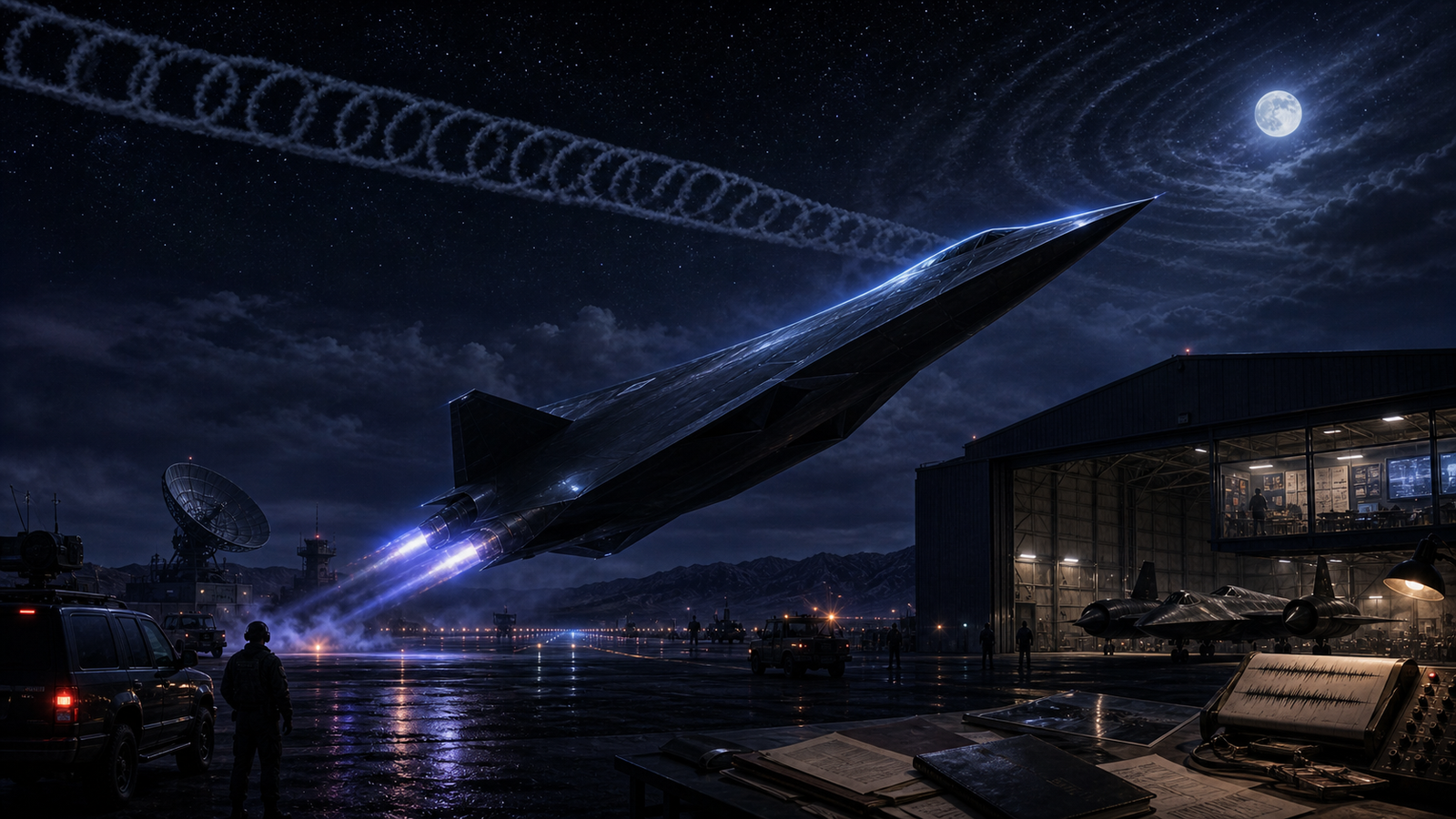
Aurora Hypersonic Spy Plane Conspiracy
Aurora became the most famous secret spy-plane rumor of the late Cold War because it seemed to appear at exactly the right moment.
There was a real reason to want it.
The SR-71 Blackbird had proven that speed and altitude still mattered in strategic reconnaissance. But once the Blackbird moved toward retirement, a question naturally opened behind it: what replaces the fastest known spy plane in the American inventory?
That question was enough to make a rumor dangerous.
When the name Aurora surfaced in a budget document, it immediately looked like an answer. And once later observers added strange sonic booms, unusual contrails, British base rumors, and claims of a Mach 5 or Mach 6 successor, Aurora stopped being a line item and became a mythology.
The strongest public record supports the history of the rumor, the strategic logic that made it believable, and the role of repeated unexplained observations in keeping it alive. It does not support the verified existence of an operational Aurora or SR-91 hypersonic reconnaissance aircraft.
What it supports is one of the clearest examples of how real black-budget secrecy can generate a myth strong enough to survive even direct denial.
Quick profile
- Topic type: conspiracy theory
- Core subject: how Aurora became the signature myth of the secret American hypersonic spy plane
- Main historical setting: mid-1980s through the 1990s, with a long afterlife in black-aircraft culture
- Best interpretive lens: not “where is Aurora now,” but “why did one name become the permanent label for an unproven high-speed reconnaissance aircraft”
- Main warning: the strongest public evidence supports the legend and its components, not a verified operational aircraft
What this entry covers
This entry is the broadest headline page for the Aurora cluster in the black-projects archive.
It covers:
- the 1985 budget-line incident,
- why the idea of an SR-71 successor mattered so much,
- how Bill Sweetman and aviation reporting shaped the theory,
- why sonic booms in Southern California became central,
- how “donuts on a rope” contrails gave the rumor a visual signature,
- why Machrihanish and Boscombe Down amplified the story,
- how Ben Rich challenged the whole aircraft claim,
- and why Aurora remained culturally alive anyway.
That matters because Aurora is not just one rumor. It is a whole framework for explaining unexplained high-speed black-aircraft traces.
The beginning: a name escapes into public view
Aurora begins not with a photograph but with a budget document.
That is why it mattered immediately.
In 1985, press reporting highlighted an apparent Pentagon budget line labeled Aurora, linked to large sums associated with black aircraft work. That alone was enough to trigger intense speculation.
At first, Aurora did not necessarily mean a hypersonic reconnaissance plane. It could have referred to a stealth bomber, a fighter, or a broader classified effort. But the name had escaped.
That matters because names make secrecy legible. Once the public thinks it knows the name of a secret program, the imagination can begin building the aircraft even if no aircraft has been shown.
Aurora was born as a label before it became a shape.
Why the SR-71 successor problem made the rumor plausible
Aurora became much stronger because it answered a real strategic question.
The SR-71 had been one of the most extraordinary reconnaissance aircraft ever fielded. Its speed, altitude, and survivability gave it a place that was hard to replace cleanly. Even when satellites and other systems grew more important, many observers remained unconvinced that the need for a fast strategic reconnaissance aircraft had simply vanished.
That mattered because Aurora fit the vacancy.
If the United States had once produced the A-12 and SR-71 in deep secrecy, then a faster, more secret successor did not feel impossible. It felt like the kind of thing the system might naturally do again.
This is why Aurora stuck. It was not only mysterious. It was strategically believable.
How Aurora shifted from a budget label to a hypersonic aircraft
The theory did not become iconic until the public began assigning performance to it.
By the late 1980s and early 1990s, Aurora was increasingly imagined as:
- a Mach 5 or Mach 6 reconnaissance platform,
- a replacement for or successor to the SR-71,
- possibly triangular, diamond-shaped, or bat-winged,
- and powered by some exotic propulsion system beyond ordinary turbojets.
That matters because once a rumor gets speed, altitude, and mission, it stops being administrative and becomes cinematic.
Aurora's evolution from a leaked name into a specific hypersonic spy plane is one of the key transformations in black-aircraft folklore.
Bill Sweetman and the architecture of belief
No discussion of Aurora works without Bill Sweetman.
Sweetman helped turn Aurora into a coherent aircraft theory by treating fragments that others might have left separate as parts of one larger puzzle:
- budget clues,
- sonic booms,
- contrails,
- technology possibilities,
- and the strategic logic of reconnaissance.
That matters because black-aircraft myths often require a systems interpreter. Someone has to build the bridge from scattered anomalies to one plausible platform.
Sweetman filled that role for Aurora. Whether one agrees with his conclusions or not, the public shape of the Aurora myth owes a great deal to his synthesis.
Sonic booms over Southern California
One of the most persistent reasons people kept believing in Aurora was the series of unexplained sonic booms reported in Southern California in the early 1990s.
This matters because booms feel objective.
A photograph can be misread. A rumor can be invented. But when seismologists, residents, and local reporters all begin talking about repeated shocks in the same general region, the story acquires physical force.
These booms were often discussed as too strong or too unusual to fit easy explanations from known routine traffic. They became a kind of atmospheric footprint for the aircraft believers thought was already there.
That does not prove Aurora. But it does explain why the theory persisted. It seemed to leave pressure waves behind it.
Why “donuts on a rope” mattered so much
Aurora also gained one of the most memorable visual signatures in black-aircraft culture: the so-called “donuts on a rope” contrails.
These strange segmented contrails were taken by believers as evidence of a pulsing or detonation-based propulsion system. That interpretation became central to the idea that Aurora used a nonstandard engine concept, sometimes linked to pulse detonation or related high-speed speculative propulsion.
That matters because contrails do what booms cannot: they create an image.
Aurora was always short on proof. It survived partly because it accumulated traces instead:
- a budget line,
- a boom,
- a contrail,
- a sound pattern,
- a route.
Those traces did not confirm the aircraft. But together they gave it the feel of a machine passing just beyond full capture.
Why propulsion speculation attached itself to Aurora
Aurora became even more compelling once propulsion theory entered the story.
The ordinary problem was clear: if the aircraft really flew at extreme speed and altitude, then it likely needed something more exotic than a conventional propulsion arrangement.
So the myth attached itself to advanced-engine language:
- pulse detonation,
- combined-cycle concepts,
- extreme thermal management,
- and hypersonic flight architectures.
That matters because technical language makes a rumor harder to dismiss inside aerospace-minded communities. Even when the specific propulsion claims remain unverified, they give the story engineering texture.
Aurora did not just become fast. It became technically suggestive.
Britain, Machrihanish, and the Atlantic edge of the myth
The theory became international when it crossed into Britain.
RAF Machrihanish in Scotland entered the Aurora story because of rumors that it functioned as a remote operating base for high-speed black aircraft moving over the North Atlantic. Observers and later reporters attached strange sounds, unusual operations, and the strategic geography of the base itself to the legend.
That matters because Machrihanish made Aurora feel operational. A secret aircraft needs not only a test range but a route, a runway, and a geography of use. Scotland gave the myth one.
This also widened the story beyond American desert lore. Aurora was no longer only a California or Nevada rumor. It had become a transatlantic black-aircraft theory.
Boscombe Down and the power of near-proof
The Boscombe Down incident further intensified the legend.
A mysterious crash or emergency involving an unknown American aircraft, followed by unusual secrecy, tarpaulins, and transport rumors, became exactly the kind of event Aurora believers needed. Even if Boscombe Down never produced verified public proof of Aurora, it felt like proximity. It felt like a glimpse of the hidden system moving awkwardly through the visible world.
That matters because near-proof is often stronger than proof in conspiracy culture. Near-proof leaves the theory alive.
A confirmed explanation ends the myth. An unexplained incident feeds it.
Ben Rich and the strongest public denial
The single strongest public challenge to the Aurora aircraft theory came from Ben Rich, the former head of Lockheed's Skunk Works.
In Skunk Works, Rich wrote that Aurora was simply the code name used for the B-2 competition funding and that the hypersonic plane itself did not exist. This is one of the most important facts in the whole story.
That matters because Rich was not an outside skeptic. He was exactly the kind of insider believers usually treat as decisive when he supports mystery. But here he cuts against the myth.
This does not automatically end the theory for believers. Some assume he was concealing a deeper truth. But it does mean that any serious treatment of Aurora has to face a load-bearing public denial from one of the most authoritative voices available.
Why the myth survived the denial
Aurora survived because the denial did not solve every part of the puzzle.
Even if Aurora was originally just a budget name for B-2-related funding, several things remained alive in public imagination:
- the continuing desire for a Blackbird successor,
- the sonic-boom reports,
- the unusual contrails,
- the British-base rumors,
- and the broader precedent that real black aircraft had often been denied before later acknowledgment.
That matters because the name no longer had to be historically exact. It only had to be useful.
Aurora became a catch-all label for any secret high-speed reconnaissance aircraft people suspected might exist. In that sense, the myth grew beyond the original budget entry.
Why Aurora became the archetype of the hypersonic black aircraft
Aurora became so powerful because it fused five things at once.
1. A real leak
The name entered public view through a real budget anomaly.
2. A real strategic vacancy
People genuinely believed the United States might want a successor to the SR-71.
3. Real sensory anomalies
Booms and contrails gave the rumor physical traces.
4. Real secrecy precedent
Programs like the F-117 and other black aircraft proved that denial could coexist with reality for years.
5. An unresolved ending
Ben Rich's explanation closed one door but did not erase the wider legend.
That combination made Aurora more than a specific aircraft rumor. It became the template for the American secret hypersonic spy plane.
Why the theory still matters
Aurora still matters because it stands at the border between proven black-program history and the zone just beyond it.
It teaches a specific lesson: when a rumor aligns with strategic logic, technological ambition, and the culture of secrecy, it can survive without decisive proof for decades.
That is why Aurora still circulates in discussions of:
- black triangles,
- exotic propulsion,
- hypersonic reconnaissance,
- and hidden successor aircraft.
It is not always because people believe the original story in a strict form. It is because Aurora became the language for the possibility itself.
What the strongest public record actually supports
The strongest public record supports this narrower conclusion:
Aurora was first known publicly as the name of a mysterious 1985 budget line associated with classified aircraft funding. As the SR-71 neared retirement, the name became attached to the idea of a secret hypersonic reconnaissance successor, and later reports of unusual sonic booms, segmented contrails, and British black-aircraft rumors helped sustain that belief. However, the strongest public counterclaim from Ben Rich states that Aurora was simply the code name for B-2 competition funding and that the hypersonic plane did not exist. The record strongly supports the history of the myth and the strategic logic that made it believable. It does not support the verified existence of an operational Aurora or SR-91 spy plane.
That is the right balance.
It preserves the reality of the rumor's origins and influence without overstating what has been demonstrated.
Why this belongs in the black-projects section
This page belongs in declassified / black-projects because Aurora is one of the purest examples of how black-program culture generates persistent aircraft mythology.
It sits at the intersection of:
- leaked nomenclature,
- reconnaissance strategy,
- sonic anomalies,
- aerospace speculation,
- and denial that never fully closes the case.
That makes it one of the foundational entries in the secret-aircraft branch of the archive.
Why it matters in this encyclopedia
This entry matters because Aurora Hypersonic Spy Plane Conspiracy explains how a black-aircraft myth becomes permanent.
It is not only:
- an Aurora page,
- a hypersonic page,
- or an SR-71 successor page.
It is also:
- a rumor-formation page,
- a sonic-boom page,
- a strategic-vacancy page,
- and a black-budget language page.
That makes it one of the central connective entries in the aviation side of the black-projects cluster.
Frequently asked questions
Was Aurora a real aircraft?
The strongest public record does not verify that Aurora was a real operational aircraft.
Where did the name Aurora come from?
It entered public view through a 1985 Pentagon budget document and became associated with classified aircraft funding.
Was Aurora supposed to replace the SR-71?
In the mythology, yes. That role is one of the main reasons the rumor became so believable.
What are “donuts on a rope”?
They are unusual segmented contrails that believers linked to Aurora's rumored propulsion system.
Why are sonic booms so important to the story?
Because repeated unexplained booms in Southern California gave the rumor a physical trace even without a confirmed aircraft.
What did Ben Rich say about Aurora?
He wrote that Aurora was the code name for B-2 competition funding and that the hypersonic plane itself did not exist.
What is the connection to Machrihanish and Boscombe Down?
Those British locations became major amplifiers of the myth by suggesting operational basing and near-proof through secrecy-heavy incidents.
Is Aurora the same thing as SR-91?
In popular black-aircraft culture, SR-91 became one of the most common labels attached to the supposed Aurora aircraft.
Why does the theory still survive?
Because it combines real secrecy precedent, real strategic plausibility, and real but inconclusive atmospheric clues.
What is the strongest bottom line?
Aurora became legendary because it transformed a leaked budget name and a reconnaissance gap into the enduring myth of an American hypersonic spy plane that was never decisively proven and never fully forgotten.
Related pages
- SR-74 Aurora Successor Aircraft Theory
- SR-91 Aurora Black Aircraft Conspiracy
- Brilliant Buzzard Hypersonic Black Project Rumor
- Blackstar Orbital Spaceplane Conspiracy
- TR-3B Astra Black Triangle Reconnaissance Conspiracy
- TR-3B Antigravity Spy Plane Black Project Theory
- DarkStar Stealth UAV Black Aircraft Program
- Project ISINGLASS Hypersonic Reconnaissance Black Project
- Project SUNTAN Hydrogen-Powered Reconnaissance Aircraft Program
- Project OXCART A-12 CIA Mach 3 Reconnaissance Program
- Project GUSTO A-12 Successor Design Study
- Project SENIOR CROWN SR-71 Operational Black Program
- Advanced Technology Bomber B-2 Black Program
- Bird of Prey Experimental Stealth Aircraft Program
- Black Projects
Suggested internal linking anchors
- Aurora hypersonic spy plane conspiracy
- Project Aurora black aircraft theory
- SR-91 Aurora history
- Aurora 1985 budget line story
- Aurora sonic booms California theory
- donuts on a rope Aurora contrails
- Machrihanish Aurora theory
- Ben Rich Aurora B-2 code name
References
- https://www.latimes.com/archives/la-xpm-1985-02-09-fi-4198-story.html
- https://archive.org/stream/Various_PDFs/SkunkWorks_APersonalMemoirOfMyYearsAtLockheed-BenRRich--_djvu.txt
- https://aerospaceweb.org/aircraft/recon/aurora/
- https://www.globalsecurity.org/military/systems/aircraft/aurora.htm
- https://www.upi.com/Archives/1992/12/04/Report-Lockheed-has-built-secret-spy-plane/8936723445200/
- https://www.latimes.com/archives/la-xpm-1992-04-17-me-607-story.html
- https://www.theguardian.com/science/2006/jun/24/freedomofinformation.usnews
- https://www.independent.co.uk/news/secret-us-spyplane-crash-may-be-kept-under-wraps-1272714.html
- https://archive.org/stream/bub_gb_IDpkBfTEN-4C/bub_gb_IDpkBfTEN-4C_djvu.txt
- https://archive.org/details/aurorapentagonss0000swee
- https://www.nasa.gov/wp-content/uploads/2021/09/495839main_fs-030_sr-71.pdf
- https://www.lockheedmartin.com/en-us/news/features/history/blackbird.html
- https://pubs.aip.org/asa/jasa/article-pdf/111/1/614/8090054/614_1_online.pdf
- https://www.cia.gov/readingroom/docs/CIA-RDP91-00901R000600390003-0.pdf
Editorial note
This entry treats Aurora as the defining myth of the secret American hypersonic reconnaissance aircraft.
That is the right way to read it.
The story became powerful because it sat at the exact crossing point of strategic plausibility and evidentiary weakness. The budget line was real enough to launch speculation. The need for an SR-71 successor was real enough to make that speculation credible. The sonic booms and unusual contrails were suggestive enough to make the theory feel physical. The British airbase and crash rumors were dramatic enough to keep it alive internationally. And Ben Rich's later denial was authoritative enough to sharpen the debate rather than end it. That combination made Aurora more than a single aircraft rumor. It became a reusable explanation for unexplained high-speed black-aircraft traces and the permanent archetype of the unconfirmed American hypersonic spy plane.