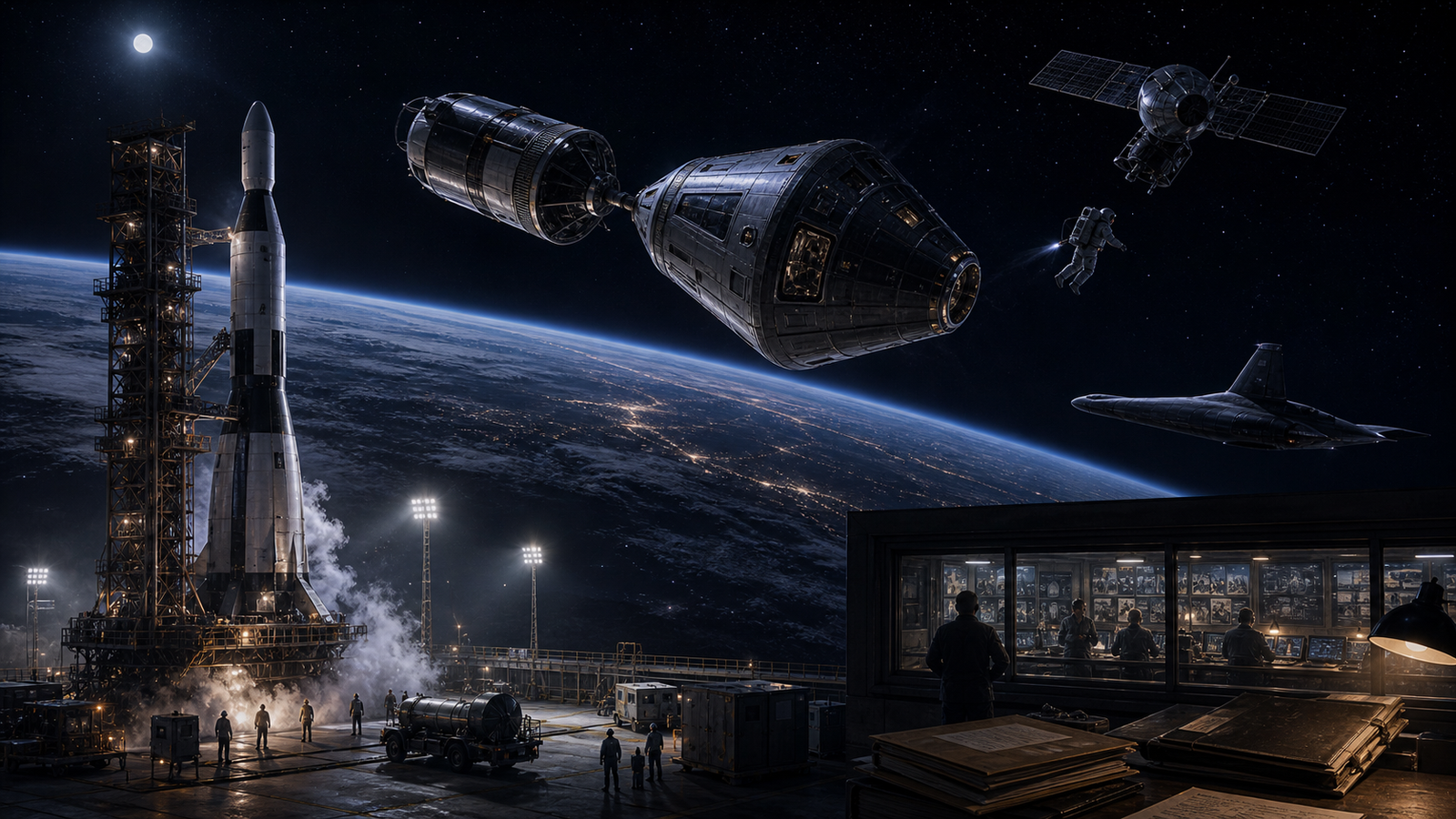
Blue Gemini Military Gemini Space Program
Blue Gemini mattered because it was the Air Force's most practical early answer to military human spaceflight.
That is the right way to read it.
Unlike Dyna-Soar, which was ambitious and technically glamorous, Blue Gemini was built around adaptation. It proposed using hardware that NASA was already developing and flying:
- a Gemini spacecraft,
- a Titan II launch vehicle,
- an Atlas,
- and an Agena rendezvous target.
That made it unusually realistic.
The strongest public record shows that Blue Gemini emerged in 1962 as a short, incremental path to getting Air Force personnel into orbit before larger military man-in-space systems were ready. It never flew. But it became one of the clearest windows into what the Air Force thought astronauts might actually do in space: rendezvous, inspect, test equipment, operate sensors, and learn how to turn orbit into a military environment.
Quick profile
- Topic type: historical record
- Core subject: how Blue Gemini would have adapted Gemini for U.S. Air Force orbital missions
- Main historical setting: 1962–1963 planning, with legacy into later MOL-era programs
- Best interpretive lens: not “what spacecraft was Blue Gemini,” but “why did the Air Force see Gemini as the fastest way to learn military orbital operations”
- Main warning: Blue Gemini was a real proposal and planning program, not a flown operational system
What this entry covers
This entry is the headline page for the Blue Gemini cluster in the black-projects archive.
It covers:
- why the Air Force wanted an early military man-in-space program,
- why Dyna-Soar and MODS were too slow for that need,
- how Program 287 formalized Blue Gemini,
- what hardware the program would use,
- what kinds of military experiments were planned,
- how its mission sequence was structured,
- why the program was canceled,
- and how its logic fed forward into Manned Orbiting Laboratory.
That matters because Blue Gemini is one of the best examples of Cold War military space thinking at its most incremental. It asked not for a huge new system first, but for a usable near-term bridge.
Why the Air Force wanted Blue Gemini
The Air Force wanted Blue Gemini because it did not want to wait.
That is the central political and operational problem behind the program.
By 1962, Air Force planners were already looking at larger military manned-space ideas such as MODS and still thinking about the delayed promise of Dyna-Soar. But those programs were years away. If the Air Force wanted early orbital experience — especially experience relevant to inspection, maneuver, docking, and military operations — it needed something sooner.
Blue Gemini solved that problem on paper by borrowing from NASA Gemini.
It was attractive precisely because it was not a moonshot inside the moonshot. It was a practical bridge.
Program 287 and the “off-the-shelf” philosophy
By October 1962, the Air Force had formally initiated Blue Gemini and described it in a Partial System Package under Program 287.
This matters because the documentation clarifies what the Air Force thought the program was for.
The goal was to provide a short-duration orbital vehicle that would:
- activate Air Force military man-in-space programs,
- demonstrate military operations and techniques,
- and test and qualify subsystems and components.
That is a very revealing mission statement.
It shows that Blue Gemini was not only about prestige or beating NASA into another lane. It was about using orbit as a proving ground.
It also shows why “off-the-shelf” mattered so much. The Air Force did not want to invent a whole new spacecraft if Gemini could get it into orbit earlier.
The hardware stack
Blue Gemini was built around four principal pieces of hardware:
- Gemini spacecraft
- Titan II launch vehicle
- Atlas launch vehicle
- Agena rendezvous target
That matters because the program was deliberately conservative in architecture. It chose systems already being built or planned, then recombined them for military purpose.
The Gemini capsule itself was intended to support one or two astronauts for up to 14 days, provide astronaut training, offer early maneuver and docking experience, and serve as a testbed for experiments and equipment.
This is one reason Blue Gemini is historically important. It turns Gemini from NASA's bridge to Apollo into the Air Force's bridge to military orbit.
Why Blue Gemini fit between Dyna-Soar and MODS
Blue Gemini only makes full sense when placed between Dyna-Soar and MODS.
Dyna-Soar represented high-end, reusable, hypersonic military space ambition. MODS represented an orbital development station path that was larger and more involved. Blue Gemini was the intermediate step.
It offered:
- earlier launches,
- simpler hardware,
- immediate crew experience,
- and a training path for both orbital operations and recovery procedures.
That matters because Blue Gemini shows the Air Force trying to think incrementally. It was not abandoning larger ambitions. It was trying to stage them.
The mission ladder: mixed NASA flights to Air Force-only missions
Blue Gemini was structured in phases.
That structure is one of the most revealing parts of the whole program.
The early phase envisioned Air Force astronauts flying on NASA Gemini missions as copilots while those missions still achieved NASA objectives. A next phase envisioned NASA Gemini flights crewed by Air Force personnel, still performing NASA-required mission goals where necessary. A later phase would move to follow-on Air Force missions focused on specifically military experiments, including rendezvous and docking with an Agena target vehicle and later dedicated equipment tests.
That matters because the program was trying to do two things at once:
- cooperate with NASA enough to gain access and experience,
- while slowly building toward fully military orbital operations.
This is a very Cold War bureaucratic design. It is partnership and institutional divergence happening at the same time.
Why the land-landing concept mattered
Another fascinating element is recovery.
At that stage, Gemini was still expected to land on land by paraglider, and the Air Force hoped Blue Gemini could recover at Edwards Air Force Base, aligning with expected Dyna-Soar recovery training. That would have required personnel, facilities, and procedures that also served the broader military manned-space effort.
That matters because Blue Gemini was not just about what happened in orbit. It was also about building an Air Force space operations culture on the ground.
Recovery training at Edwards connected Gemini directly to the Air Force's larger manned-space vision.
What the Air Force thought astronauts would actually do in orbit
Blue Gemini is important because its planned experiments reveal what the Air Force thought humans in orbit were good for.
The proposed uses included:
- Astronaut Maneuvering Unit testing
- rendezvous and docking
- inspection of non-cooperative targets
- stellar inertial guidance evaluation
- deployable structure observation
- ground-mapping radar
- optical, infrared, and radio-frequency intelligence sensors
That matters because these are not generic “military in space” ideas. They are quite specific.
Blue Gemini imagined astronauts as:
- inspectors,
- evaluators,
- sensor operators,
- repair or adjustment-capable observers,
- and participants in rendezvous missions that could scale into more operational inspection or counterspace roles later.
This makes Blue Gemini one of the clearest early case studies in what the military thought orbital humans were for before experience proved how much could be done more cheaply by robots.
The AMU and untethered maneuvering
One top priority was the Astronaut Maneuvering Unit, or AMU.
This matters because AMU testing shows how close Blue Gemini sat to the problem of free maneuver in orbit. The Air Force wanted astronauts who could move around spacecraft independently and test rendezvous-and-inspection techniques in a meaningful way.
The unit was a precursor in spirit to much later maneuvering backpacks. In the Blue Gemini context, it shows that the Air Force already imagined astronauts doing more than sitting inside capsules. It wanted them active outside the spacecraft.
“Non-cooperative targets” and the inspection mission
One of the most striking proposed mission areas involved what the documents called “non-cooperative targets.”
That phrase matters because it is euphemistic and revealing.
It suggests inspection or approach operations involving satellites or objects that were not simple friendly rendezvous partners. That puts Blue Gemini close to the early logic of:
- orbital inspection,
- satellite interception,
- and human-in-the-loop space control.
This is one reason the program links so naturally to Project SAINT and later counterspace and inspection concepts.
Blue Gemini was not yet a weapon system. But it was clearly thinking in that direction.
Radar and reconnaissance payloads
Another ambitious proposal involved replacing one crew position with equipment and using the extra space for a ground-mapping radar or other intelligence sensors.
That matters because it connects Blue Gemini to the history of space-based reconnaissance experimentation. The Air Force was already imagining astronauts helping evaluate radar, optical, infrared, or signals-intelligence packages in orbit.
This also creates a direct conceptual bridge to later programs such as QUILL and, farther out, to the manned reconnaissance logic of MOL / DORIAN.
Blue Gemini, in that sense, is not only a spaceflight story. It is also a reconnaissance story.
Why NASA and the Pentagon clashed over it
Blue Gemini also mattered because it created a bureaucratic fight.
NASA officials initially saw advantages in closer Air Force reliance on Gemini, especially if that sharing reduced costs. But the situation changed as the Pentagon's civilian leadership moved toward a more aggressive posture, including discussion of deeper Department of Defense control over Gemini itself.
That mattered because NASA feared losing focus on Gemini's Apollo-supporting role. For NASA, Gemini was a bridge to the Moon. For the Air Force, Blue Gemini was a bridge to military orbit. Those are different futures, even if they share a spacecraft.
This is where Blue Gemini became more than a technical program. It became a struggle over who controlled American human spaceflight below the Moon.
Why McNamara killed it
By early 1963, McNamara killed Blue Gemini and MODS as part of a broader rejection of proposed new Air Force space programs.
That matters because Blue Gemini's death was not really about the spacecraft. It was about policy, duplication, budgets, and institutional control.
The strongest historical reading is that McNamara saw the Air Force's manned-space ambitions as too expansive and too overlapping with NASA. Blue Gemini may have been practical, but that did not make it politically safe.
This is why its cancellation matters so much. It marks the point where a realistic military Gemini path lost to a different view of what national space priorities should be.
What survived after cancellation
The program died, but not everything in it disappeared.
Some proposed ideas and experiments migrated into NASA Gemini thinking, even if not all of them were fully realized. And the larger Air Force logic — that Gemini-derived hardware could support military orbital work — survived most clearly in Manned Orbiting Laboratory and Gemini B.
That matters because Blue Gemini is best understood as a program that lost institutionally but won historically. Its concepts outlived its approval.
Blue Gemini to MOL
The most visible legacy of Blue Gemini is MOL.
The National Museum of the U.S. Air Force explicitly describes MOL as an evolution of the earlier Blue Gemini idea. That matters because it proves the Air Force did not abandon the underlying concept of manned military orbit. It simply restructured it.
Where Blue Gemini was incremental and short-duration, MOL became larger, more formal, more reconnaissance-centered, and more expensive. But the family resemblance is obvious: Gemini-derived crew vehicle, military astronauts, and a continuing attempt to prove that humans in orbit had military value.
Why Blue Gemini mattered more than its lifespan suggests
Blue Gemini existed only briefly in formal terms. That is true.
But it still matters because it was the most logical of the Air Force's early manned-space proposals. It used ready hardware, reasonable timelines, and carefully staged missions to answer a real institutional question: what can a military astronaut do in orbit that justifies the effort?
That is one of the most important questions in Cold War space history. Blue Gemini is a clean early version of it.
What the strongest public record actually supports
The strongest public record supports this narrower conclusion:
Blue Gemini was a real 1962 U.S. Air Force proposal, formalized as part of Program 287, to use largely off-the-shelf Gemini, Titan II, Atlas, and Agena hardware for a phased series of military orbital missions beginning with NASA cooperation and leading toward dedicated Air Force flights. Its goals included astronaut training, rendezvous, docking, equipment qualification, AMU testing, inspection of non-cooperative targets, and reconnaissance-related sensor experiments. It was canceled in early 1963 amid NASA–DoD conflict and McNamara's broader effort to restrain Air Force manned-space ambitions. Its logic and some of its hardware lineage survived most clearly in Manned Orbiting Laboratory and Gemini B.
That is the right balance.
It preserves Blue Gemini's importance without pretending it became an operational flown program.
Why this belongs in the black-projects section
This page belongs in declassified / black-projects because Blue Gemini sits at the intersection of:
- military orbital operations,
- Gemini-derived spacecraft adaptation,
- rendezvous and inspection doctrine,
- reconnaissance experimentation,
- and Cold War institutional struggle.
It is not conspiracy lore. It is real policy and program history that shaped later classified space ambitions.
That makes it foundational.
Why it matters in this encyclopedia
This entry matters because Blue Gemini Military Gemini Space Program explains how the military tried to enter orbit by adaptation rather than by building an entirely new world first.
It is not only:
- a Gemini page,
- a military space page,
- or a canceled program page.
It is also:
- a doctrine page,
- a rendezvous-and-inspection page,
- a NASA–Air Force conflict page,
- and a bridge-to-MOL page.
That makes it one of the key connective entries in the military-space side of the archive.
Frequently asked questions
Was Blue Gemini a real program?
Yes. It was a real Air Force proposal and planning effort in 1962, though it never flew operational missions.
Was Blue Gemini the same as Gemini B?
No. Blue Gemini was the earlier Air Force military-Gemini proposal. Gemini B was the later Gemini-derived spacecraft developed for MOL.
Why did the Air Force want Blue Gemini?
Because it wanted early military orbital experience before larger programs like MODS or Dyna-Soar could be ready.
What hardware would Blue Gemini have used?
Mainly Gemini spacecraft, Titan II launch vehicles, Atlas boosters, and Agena targets, with limited modifications.
What kinds of missions were proposed?
Rendezvous, docking, astronaut maneuvering, inspection of non-cooperative targets, sensor evaluation, and military orbital training.
Did Blue Gemini include reconnaissance ideas?
Yes. Proposed payloads included radar, optical, infrared, and signals-related equipment, as well as inspection-style missions.
Why was it canceled?
Because of budget and policy decisions, overlap with NASA Gemini, and McNamara's broader effort to limit Air Force manned-space expansion.
What came after Blue Gemini?
Its most visible institutional successor was the Manned Orbiting Laboratory, which used Gemini-derived hardware and pursued a more developed military-space role.
What is the strongest bottom line?
Blue Gemini mattered because it was the Air Force's clearest early attempt to use existing Gemini hardware to learn real military orbital operations quickly, and its cancellation helped shape the path toward MOL instead.
Related pages
- Dyna-Soar X-20 Military Spaceplane Program
- Manned Orbiting Laboratory Military Space Station Program
- Project DORIAN MOL Giant Camera Black Program
- Project SAINT Satellite Inspector Black Program
- Program 437 Thor Anti-Satellite Black Program
- Project QUILL Radar Imaging Satellite Program
- Project HORIZON Army Lunar Outpost Program
- Project LUNEX Air Force Moonbase Program
- Project ISINGLASS Hypersonic Reconnaissance Black Project
- Black Projects
Suggested internal linking anchors
- Blue Gemini military Gemini space program
- Blue Gemini Program 287 history
- USAF military Gemini program
- Blue Gemini MODS MOL lineage
- Blue Gemini McNamara cancellation
- Blue Gemini rendezvous with non cooperative targets
- Blue Gemini AMU spacewalk testing
- Air Force Gemini military space concept
References
- https://www.thespacereview.com/article/4448/1
- https://www.thespacereview.com/article/582/1
- https://www.nationalmuseum.af.mil/Visit/FactSheets/Display/Article/195891/manned-orbiting-laboratory/
- https://www.afmc.af.mil/News/Article-Display/Article/1925643/history-in-two-dyna-soar/
- https://www.nasa.gov/gemini/
- https://www.nasa.gov/wp-content/uploads/2023/03/sp-4203.pdf
- https://www.nasa.gov/mission/gemini-ii/
- https://www.nro.gov/Portals/65/documents/history/csnr/programs/docs/MOL_Compendium_August_2015.pdf
- https://www.nro.gov/Portals/65/documents/foia/declass/mol/379.pdf
- https://www.space.com/30897-air-force-manned-orbiting-lab-astronauts.html
- https://bpb-us-e1.wpmucdn.com/sites.tufts.edu/dist/2/7314/files/2018/09/1994-Peter-Lang-Hays-Struggling-towards-space-doctrine.-U.S.-military-space-plans-programs-and-perspectives-during-the-cold-war.pdf
- https://www.lockheedmartin.com/en-us/news/features/history/titan.html
- https://www.britannica.com/technology/Titan-rocket
- https://www.secretsdeclassified.af.mil/News/Photos/igphoto/2003583749/
Editorial note
This entry treats Blue Gemini as one of the most historically revealing canceled military space programs of the early Cold War.
That is the right way to read it.
It never flew, so it can be overshadowed by more dramatic names like Dyna-Soar or MOL. But in some ways it is more revealing than either. Blue Gemini shows the Air Force trying to answer a practical question with available hardware. Instead of waiting for a more elegant future system, it proposed using Gemini now. That made it a uniquely direct expression of Cold War military-space thinking: use orbit as a training ground, use astronauts as operators and inspectors, adapt what already exists, and learn fast. Its cancellation proved that practicality alone did not decide space policy. But its legacy in MOL shows that the underlying question never went away.